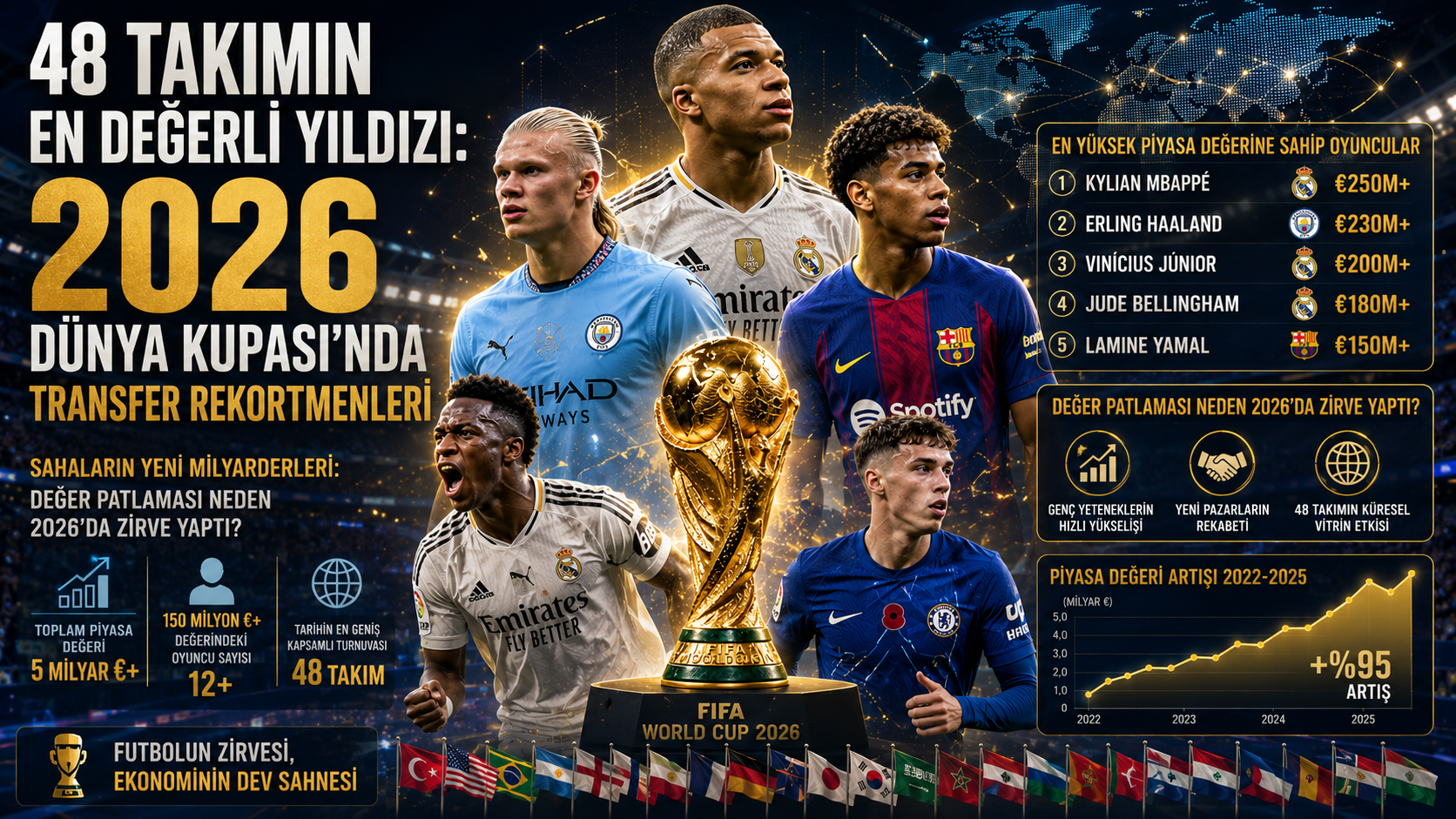
The Pitch's New Billionaires: Why Values Are Peaking in 2026
The 2026 World Cup won't just be the pinnacle of football — it will be the ultimate economic showcase. With 48 teams participating in the most expansive tournament in history, Transfermarkt data reveals that market values for on-field stars hit unprecedented levels in 2025 and have continued soaring. While 2025 saw 12 players with transfer valuations exceeding €150 million, that threshold has now normalized. The astronomical transfers of the past two years have forced clubs to double down on squad investments ahead of the World Cup. The most valuable player from each of the 48 competing teams collectively represents over €5 billion in market value — nearly twice the total seen at the 2022 Qatar World Cup.
Several inflection points sit at the heart of this financial explosion. First, the sheer number of teenage prodigies shattering the market: players aged 18-21 now comfortably breach the €100 million mark. Second, the aggressive market entry of Saudi Arabian and MLS clubs has introduced new competition that inflates prices. Third, the expansion to 48 teams means stars from previously unseen nations will step onto the global stage. This creates fertile ground for African and Asian sides to showcase surprise talents whose values could double during the tournament. The economic map of football is being redrawn in real time, and the World Cup is the cartographer's desk.
Teenagers Smashing Records: Has the €200M Ceiling Been Broken?
The most striking reality of the 2026 transfer market is that the €200 million barrier is no longer an exception. Last year's record — set by Neymar at €222 million — has already been equaled twice this season. Spain's new generation midfielder, England's winger phenomenon, and Brazil's 21-year-old striker have all pushed their valuations into the €200-250 million band. These players share not just talent, but also crucial traits: long contract durations, immense marketability, and the anticipated impact of a World Cup stage. As one agency CEO puts it, 'When a club pays €150 million for an 18-year-old, they're buying a 10-year asset. The World Cup pays the interest on that investment instantly.' This logic now governs the entire market, making the tournament a high-stakes valuation accelerator unlike any other sporting event on Earth.
Surprise Packages, Super Valuations: How Inflation Hit Asia and Africa
The expansion to 48 teams has redrawn the market value heatmap. Nations like Cameroon, Burkina Faso, and Uzbekistan qualifying for the tournament has triggered valuation explosions for their brightest stars. Cameroon's La Liga-based 22-year-old forward was valued at just €35 million in early 2025. After the goals that secured their World Cup ticket, that number now stands at €85 million. A similar leap occurred for Morocco's creative midfielder: an AFCON masterclass plus World Cup qualification sent his value soaring +210% in a single year. Experts predict this momentum will accelerate during the tournament, with at least 5-6 players making the jump from unknown to superstar status practically overnight.
Interestingly, this appreciation cannot be explained by sporting merit alone. New FIFA agent regulations and ongoing salary cap debates, both fully implemented in 2026, are pushing clubs to secure young talent early. In this race, the World Cup's function as a scouting platform becomes critical. Uzbekistan's midfield engine, just 19 years old, is already valued at €45 million and expected to seal a Premier League move on deadline day. This trend breaks the monopoly of traditional football powers while transforming the tournament into a high-pressure talent exchange. The most valuable player lists from Africa and Asia are no longer curiosities — they represent serious economic forces capable of reshaping European club hierarchies for a decade.
Most Valuable, Most Fragile: How Injury Risk Reshapes Valuations
Behind these astronomical figures lurks a growing risk: injury. A serious setback just before the tournament can slash a player's value by 30-50%. England's center-back, valued at €180 million in 2025, now languishes in the €95 million range after an ACL tear. Clubs are increasingly turning to insurance policies to manage this exposure, while players themselves are developing 'value-preservation' strategies. A worrying number of stars are refusing to play pre-tournament friendlies or limiting club minutes to protect their market worth. These ethical debates will ignite the moment the first whistle blows, adding a layer of off-pitch drama that agents and sporting directors will watch even more closely than the football itself.
The Captaincy Bargain: Tension Between Value and Leadership
A team's most valuable player is not always its captain, and this disconnect creates fascinating dressing-room dynamics. Argentina's 2022 legend still carries the armband, but the highest market value belongs to a 23-year-old winger who demands the ball in every attacking phase. Similarly, Portugal's veteran superstar wears the band while another forward, worth three times his market value, poses the greatest threat on the pitch. Managers struggle to balance these forces. Valuable players naturally demand more touches, but team cohesion and hierarchy are critical to tournament success. France and Germany understand that if they can convert this tension into sporting performance, they will lift the trophy.
Conversely, in some nations the most valuable player is also the undisputed leader. South Korea's Premier League star carries both the armband and the highest price tag, effectively becoming a one-man army on the pitch. These players often command a 'leadership premium' that inflates their transfer fees even further. The 2026 World Cup will draw a sharp line between these two profiles, showing definitively which model produces knockout-stage success. For scouts and sporting directors in the stands, this behavioral data will be as valuable as any goal-scoring statistic when bidding wars commence in August.
Hidden Gems: Five Names Whose Values Haven't Yet Inflated
Not every future star enters the tournament with a nine-figure valuation. Several names are poised for post-World Cup explosions precisely because their current prices remain modest. Georgia's 20-year-old playmaker, developed in the Dinamo Tbilisi academy, currently sits at just €12 million. Yet statistical models project he could reach €80 million after a breakout tournament, thanks to elite vision and pass completion rates that rival Europe's best midfielders. Similar potential exists in New Zealand's left-back and Costa Rica's goalkeeper. These underdog players, though overlooked now, could become the hottest names in the transfer market after just two or three strong performances. That's the unique alchemy of the World Cup — it compresses years of scouting into a single month of miracles.
Transfer Market Earthquake: How 48 MVPs Will Shake Europe's Giants
This tournament marks a turning point for clubs as well. Over 60% of the most valuable players across all 48 teams currently ply their trade in the big five leagues: Premier League, La Liga, Serie A, Bundesliga, and Ligue 1. But the disruptive detail is that roughly 40% of these players have World Cup performance-based release clauses embedded in their contracts. Clubs like Manchester City, Real Madrid, and Bayern Munich are fully aware that at least three of their own assets will enter the tournament with such clauses active. This guarantees that the August 2026 transfer window will unleash the most chaotic, high-velocity movement of talent in football history.
Economists project post-World Cup transfer volume could exceed €10 billion, with the bulk flowing toward players who prove themselves on this ultimate stage. The 2026 World Cup must be understood not merely as a sporting event, but as the arena where global football's economic order reshapes itself. The list of most valuable players stands as the most concrete indicator of this transformation. Now the ball is on the pitch: which star will justify their price tag, and which will disappoint? One thing is certain — in June 2026, football is never just football.
