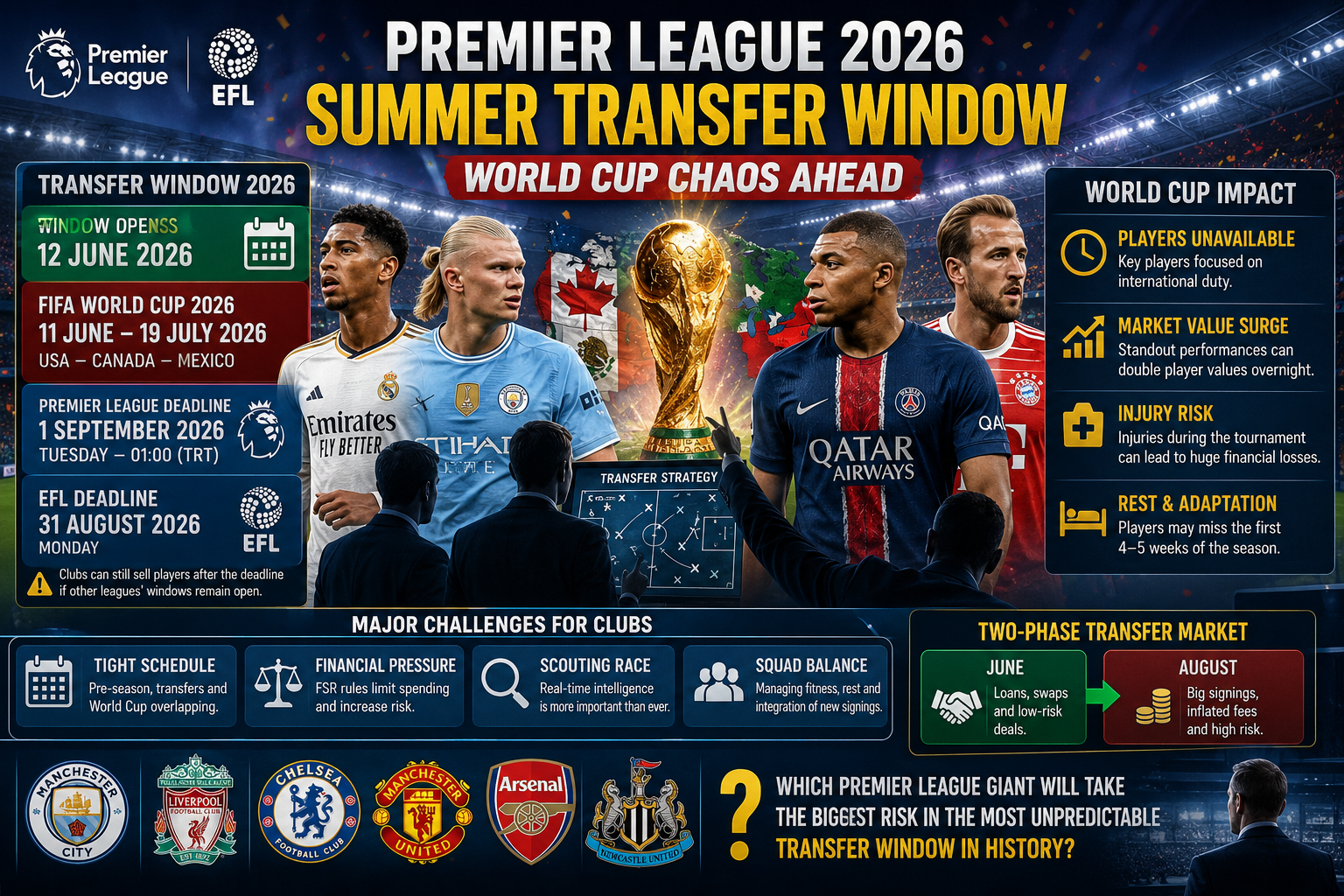
Transfer Window and World Cup Collision
For the Premier League and the English Football League (EFL), the 2026 summer transfer window is shaping up to be one of the most complex logistical equations in football history. Normally, clubs manage pre-season camps, player contracts, and transfer budgets within a structured calendar, but this year, the expanded 48-team FIFA World Cup throws every parameter into disarray. The window officially opens on June 12, yet the tournament hosted by the USA, Mexico, and Canada runs from June 11 to July 19. This means that the vast majority of high-profile international stars will be physically unavailable for transfer negotiations during the peak weeks. Premier League sporting directors will have to balance the stark differences in rest and adaptation between players returning from holiday and those battered by a deep World Cup run.
Concrete timeline: When is Deadline Day?
Sticking to tradition, the Premier League has set the Deadline Day for the 2026 summer window on Tuesday, September 1, at 11:00 PM local time. For EFL clubs, the finish line will close a day earlier, on the night of Monday, August 31. A crucial detail looms: if rival leagues outside Europe, such as the Turkish Süper Lig or the Saudi Pro League, extend their windows until mid-September as they did in 2025, English teams will face a chaotic scenario where they can sell but cannot register new players. This holds the potential for a devastating domino effect, specifically for clubs leaving their squad engineering to the final week.
Strategic Nightmares Under the World Cup Shadow
The summer of 2026 will not just be a transfer window; it will be a test of patience on a grand scale. A player who shines at the World Cup could see their market value double overnight. We witnessed this phenomenon in Qatar 2022 with Enzo Fernández and Sofyan Amrabat, where prices skyrocketed instantly. Now, with a larger tournament stage and a greater pool of potential stars, the volatility will be extreme. Club scouting departments must operate not only to analyze matches but to deliver real-time market intelligence to CEOs under immense pressure. Conversely, a club pushing to sign a contract before the tournament faces a financial nightmare if that target suffers a serious injury in North America.
The rest and adaptation crisis
FIFA's mandatory rest protocols require players who feature in at least two World Cup matches to take 21 days off. If a player's nation marches to the final on July 19, that footballer cannot join their new club until mid-August at the earliest. This implies new signings would miss the first 4 to 5 weeks of the domestic season. Top managers like Pep Guardiola and Jürgen Klopp have long criticized this calendar congestion, and in 2026, it will strike EFL Championship clubs just as hard, derailing the promotion plans of teams who hesitated in the early market.
Financial Tightropes and Smart Gambles
The strict Financial Sustainability Rules (FSR) enforced since 2025 will show their teeth fully in 2026. Clubs must offset massive transfer fees against amortization obligations. A massive gamble looms between those trying to exploit a 'quiet' pre-World Cup market for discounts and those diving into the post-tournament frenzy of inflated fees. For instance, a South American forward a Premier League side could secure for £30 million in early June might skyrocket to £60 million after a three-goal group stage performance. This equation creates a level of psychological pressure that will turn sporting directors' nerves into shards of glass.
Dual-market reality for clubs
Experts are forecasting a 'dual-market' reality for this summer: a period dominated by loans and swaps before the World Cup (in June), and a 'crazy money' period in August. Consequently, in 2026, financial giants like Chelsea and Newcastle will feel the tightrope walk between fiscal discipline and sporting success more acutely than ever before.
Conclusion: Who Will Master This Historic Window?
The 2026 summer transfer window for the Premier League and the EFL will test not just the players but the agility of managers and CEOs alike. The time pressure created by the World Cup, combined with injury risks and skyrocketing prices, turns this window into modern football's greatest strategic battle. Clubs that move fast, finalize smart pre-agreements before the tournament, and utilize their scouting networks like intelligence agencies will start the 2026/27 season a step ahead of their rivals. Which Premier League giant do you think takes the biggest gamble on this grand chessboard?
