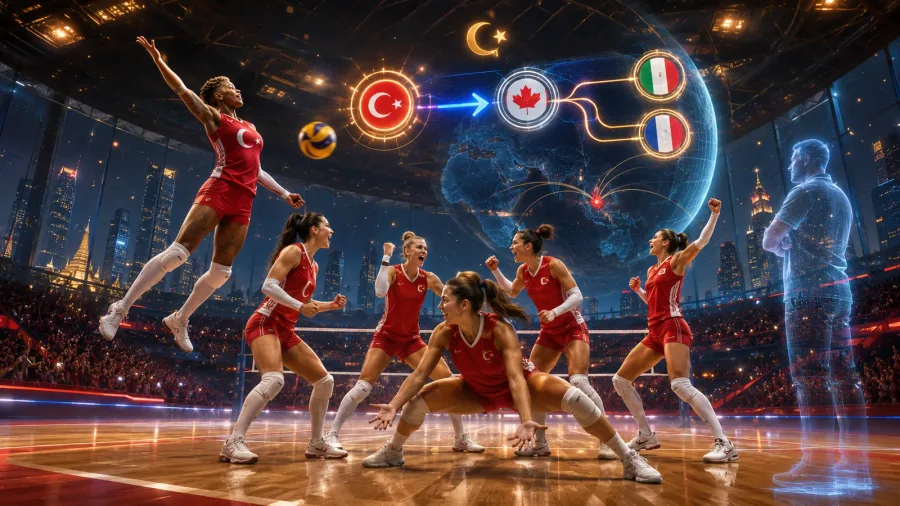
The stage is set for the knockout phase of the 2026 FIVB Volleyball Nations League, and Turkey's national women's team has learned its path to the podium. The Sultans of the Net, one of the most dominant forces in international volleyball over the past three years, will begin their quest for a second VNL title against Canada in the quarterfinals on July 23 in Bangkok, Thailand. The matchup carries extra intrigue as it pits Turkey's current head coach Daniele Santarelli against his former mentor Giovanni Guidetti, now in charge of the Canadian squad.
The 2026 VNL finals represent a critical juncture for a Turkish program that has transformed from a regional power into a genuine global contender. After capturing their maiden VNL championship in 2023 and reaching the Olympic semifinals in Paris 2024, the team experienced a relative dip in 2025, failing to medal in the same competition. Now, with a blend of seasoned veterans and emerging talent, Turkey enters the Bangkok finals as the third seed, determined to reassert its dominance on the world stage. Here is a comprehensive breakdown of the schedule, the opponents, and the tactical battles that will define this campaign.
The quarterfinal matchup: Turkey vs. Canada and the Guidetti subplot
When Turkey takes the court against Canada on July 23 at 17:00 local time (10:00 GMT), the sidelines will feature a compelling coaching duel. Giovanni Guidetti, the Italian tactician who managed Turkey's national team from 2017 to 2022, now leads a Canadian side that has steadily climbed the world rankings. Guidetti's intimate knowledge of Turkish volleyball's infrastructure and his personal relationships with players like Eda Erdem Dündar and Zehra Güneş add a layer of psychological complexity to this elimination match. Daniele Santarelli, who served as Guidetti's assistant before succeeding him, has since eclipsed his mentor's achievements by winning the VNL title and multiple club world championships with Imoco Volley Conegliano.
On the court, the matchup appears favorable for Turkey on paper. The Sultans of the Net boast one of the most formidable rosters in the world, headlined by Cuban-born opposite Melissa Vargas, whose powerful attacking from the right side has made her virtually unguardable at this level. Canada's hopes rest on the shoulders of Kiera Van Ryk, a star in Italy's Serie A1, and outside hitter Alexa Gray. However, Canada's lack of depth compared to Turkey's 14-player rotation could prove decisive in a high-pressure, single-elimination format. The teams last met in the 2025 VNL preliminary round, with Turkey securing a 3-1 victory behind Vargas's 28-point performance.
Scouting report: Canada's offensive weapons and Turkey's blocking strategy
Turkey's coaching staff has identified Canada's transitional attack as the primary threat. Van Ryk's ability to score from the back row and Gray's sharp angle hits require disciplined block positioning from middle blockers Zehra Güneş and Aslı Kalaç. Turkey led all VNL teams in blocking statistics during the preliminary phase, averaging 3.2 stuff blocks per set. If the Turkish wall can neutralize Canada's wing spikers early, the match could tilt decisively in favor of the higher seed. Santarelli is expected to deploy an aggressive serving strategy to disrupt Canada's reception, forcing Guidetti's team into predictable offensive patterns.
Bangkok finals: Full schedule and semifinal scenarios
The 2026 VNL finals will unfold over four days at the Indoor Stadium Huamark in Bangkok, a venue with a capacity of 15,000 spectators. The quarterfinal round on July 23 features four matches: Brazil against Japan, the United States versus Poland, Italy against France, and Turkey against Canada. The winners will advance to the semifinals on July 25, with the medal matches scheduled for July 26. Should Turkey defeat Canada, it would face the winner of Italy-France in the semifinals. Italy, the top-ranked team in the world and reigning VNL champion from 2024, looms as Turkey's most likely obstacle to the final.
A potential Turkey-Italy semifinal would be a rematch of the 2024 Paris Olympics semifinal, which Italy won in a tense four-set battle. That defeat has lingered in the memory of Turkish players and fans alike, making a Bangkok rematch one of the most anticipated storylines of the tournament. Italy, coached by Julio Velasco, has maintained its tactical discipline and defensive prowess, but Turkey's offensive firepower, particularly through Vargas and outside hitter Hande Baladın, gives it a legitimate chance to flip the script. The other side of the bracket features perennial powerhouse Brazil against Japan, and the United States against Poland, ensuring a star-studded final weekend regardless of the outcomes.
Venue and climate: The Bangkok adaptation challenge
Hosting the finals in Bangkok presents unique logistical challenges for the participating teams. The tropical climate, with humidity levels often exceeding 80%, can affect player endurance and the ball's flight characteristics in the indoor arena. Teams traveling from Europe and the Americas face a significant time zone adjustment of up to seven hours. The Turkish Volleyball Federation has arranged for the national team to arrive in Bangkok five days before the quarterfinal, allowing for acclimatization sessions. This decision reflects lessons learned from the 2025 finals, where several European teams struggled with late-game fatigue in humid conditions. Thailand's passionate volleyball fanbase is also expected to create an electric atmosphere, though the neutral venue removes any home-court advantage for the Asian participants.
Turkey's road to Bangkok: Preliminary round analysis and key statistics
Turkey concluded the 2026 VNL preliminary round with a 9-3 record, good for third place in the overall standings behind Brazil and Italy. The team's offensive output was spearheaded by Melissa Vargas, who amassed 217 total points across 12 matches, ranking her second among all scorers in the competition. Captain Eda Erdem Dündar, at age 38, continued to defy expectations with her blocking efficiency and leadership, while libero Gizem Örge anchored the backcourt defense with a reception efficiency rate above 65%.
Despite the strong record, the preliminary phase exposed vulnerabilities that elite opponents could exploit. Turkey's three losses came against Brazil, Italy, and a surprising defeat to Poland, and in each match, serve reception emerged as the critical weakness. Opponents targeted Turkey's outside hitters with jump serves, disrupting the offensive rhythm and forcing Vargas into difficult attacking situations. Santarelli has dedicated significant training time to this issue in the weeks leading up to the finals, with young outside hitter İlkin Aydın showing marked improvement in reception drills. The coaching staff's ability to shore up this area will likely determine how deep Turkey can advance in the knockout stage.
Santarelli's rotation management and the integration of young talent
One of Santarelli's defining strategies in 2026 has been his careful management of player workloads. Recognizing the grueling nature of a summer that also includes the World Championship qualifiers, the Italian coach has rotated his squad more aggressively than in previous years. Promising young opposite hitters have been given meaningful minutes behind Vargas, reducing the star player's physical burden. This depth could prove decisive in a tournament format where teams must play three high-intensity matches in four days to claim the title. The emergence of middle blocker Aslı Kalaç as a reliable rotation option alongside Zehra Güneş has also strengthened Turkey's net defense, providing Santarelli with tactical flexibility.
The business of success: Turkey's volleyball economy and global brand in 2026
The rise of Turkish women's volleyball has transcended sport, becoming a significant cultural and economic phenomenon. As of 2026, the Turkish Volleyball Federation's sponsorship revenues have tripled compared to the pre-2023 era, with major corporations including Türk Hava Yolları (Turkish Airlines) and Vestel investing heavily in the national team's brand. Television ratings for Sultanlar Ligi matches regularly surpass those of many football broadcasts, a remarkable shift in a country historically dominated by the beautiful game. The Sultans of the Net have become household names, with Melissa Vargas and Zehra Güneş ranking among Turkey's most marketable athletes.
On the international stage, Turkey's success has elevated the profile of the VNL itself. The federation's strategic hosting of major events, including the 2025 European Championship finals in Istanbul, has positioned Turkey as a global hub for the sport. A strong performance in Bangkok—and especially a gold medal—would further cement this status and unlock additional commercial opportunities. For the players, the stakes are equally high. A VNL title would provide a significant confidence boost ahead of the 2028 Los Angeles Olympics qualifying cycle, while also solidifying Turkey's claim as the world's premier volleyball nation alongside traditional powers Brazil and Italy.
Fan mobilization and digital engagement
The Turkish fanbase has evolved into one of the most organized and passionate in international volleyball. For the Bangkok finals, hundreds of supporters are expected to travel from Turkey and the Turkish diaspora in Europe and Asia, transforming the Huamark Indoor Stadium into a de facto home venue. The Turkish Volleyball Federation has partnered with travel agencies to offer official supporter packages, and social media campaigns under hashtags like #FileninSultanları and #VNL2026 have generated millions of impressions. This digital engagement has attracted the attention of global sponsors, creating a virtuous cycle where fan enthusiasm drives commercial investment, which in turn funds better training facilities and youth development programs across Turkey's 81 provinces.
