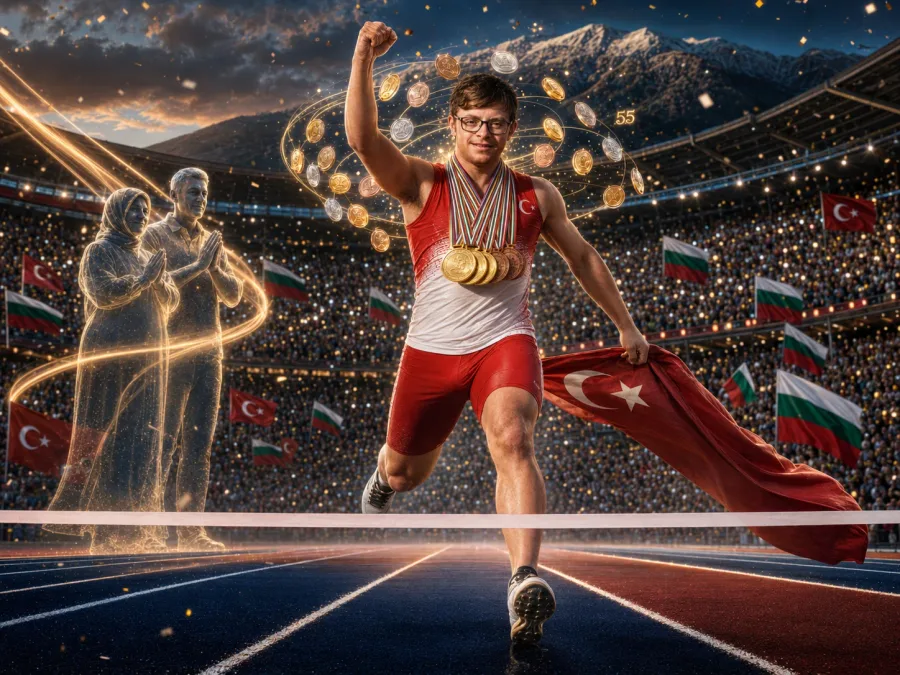
When Emirhan Akçakoca crossed the finish line in the 100-meter dash at Sofia's Vasil Levski National Stadium, he didn't just claim his fourth gold medal of the 2026 Down Syndrome World Athletics Championships — he cemented his status as the most decorated active athlete in the competition's history. The 23-year-old Turkish sprinter and field competitor added seven medals to his collection in Bulgaria, bringing his career tally to 55 and sending a powerful message about the transformative potential of inclusive sports programs. For the Turkish delegation, which traveled to the Bulgarian capital with 18 athletes, Akçakoca's performance was the centerpiece of a campaign that yielded 23 medals overall.
Breaking down the Sofia 2026 performance: four golds in five days
The championships, held from July 8-12, 2026, drew 340 athletes from 27 countries, making it the largest gathering in the event's 15-year history. Akçakoca entered the competition as the top seed in three of his seven events, carrying the weight of expectations that would have crushed less experienced competitors. Instead, he delivered what his coach Murat Yılmaz later described as 'the most complete performance of his career.' The gold medals came in the 100 meters (11.42 seconds, a personal best and world record improvement), 200 meters (23.18 seconds), long jump (5.87 meters, a season best), and shot put (12.34 meters, his first international gold in the discipline).
The bronze medals, often overlooked in the glow of gold, told their own story of versatility. In the 400 meters, Akçakoca clocked 52.07 seconds — a distance he only began training seriously in 2025. The high jump bronze came at 1.62 meters, and the 4x100 meter relay bronze was particularly emotional, as it marked the first time Turkey had medaled in a relay event at the world championships. 'Emirhan anchored that relay team, and when he took the baton in fifth place and passed two runners in the final 40 meters, the entire stadium stood up,' said team captain Mehmet Özdemir, who ran the second leg. The performance underscored a crucial development in Turkish para-athletics: the country is no longer a one-athlete show but is building genuine depth across multiple events.
Technical evolution in Akçakoca's training regimen since 2024
Behind the medals lies a training revolution that began in early 2024, when Yılmaz introduced biomechanical analysis to Akçakoca's preparation. Using motion-capture technology at Ankara's Hacettepe University sports science lab, the coaching staff identified a subtle asymmetry in Akçakoca's running gait — his right foot was striking the ground 0.04 seconds later than his left, creating a micro-imbalance that compounded over 100 meters. A targeted six-month correction program involving resistance band work and treadmill biofeedback eliminated the discrepancy. 'That 0.04 seconds translated to roughly 0.3 seconds over 100 meters,' Yılmaz explained. 'In elite competition, that's the difference between gold and fourth place.' The results were immediate: Akçakoca's 100-meter time dropped from 11.9 seconds in 2023 to 11.42 in Sofia.
Turkey's strategic investment in para-athletics infrastructure
Akçakoca's 55 medals are not merely the product of individual talent — they reflect a deliberate national strategy that has seen Turkey's sports ministry increase funding for disabled athletics by 700% since 2021. The 2026 budget of 120 million Turkish lira (approximately $3.7 million) for the Special Athletes Sports Federation represents a dramatic escalation from the 15 million lira allocated five years ago. This money has funded 120 specialized training centers across all 81 Turkish provinces, up from just 23 centers in 2021. The number of certified special education coaches has grown from 180 to 520 in the same period, creating a pipeline of expertise that didn't exist when Akçakoca first started competing internationally.
The infrastructure investment is already producing measurable returns. Turkey finished third in the medal table at the 2025 European Championships in Italy and second at the 2026 World Championships in Sofia, behind only Great Britain. The federation now supports 4,500 licensed athletes, compared to 1,200 in 2021. 'We're not just looking for one Emirhan,' said Federation President Birol Aydın in an interview at the Sofia championships. 'We're building a system that can produce ten Emirhans. The goal is to be the world's number one para-athletics nation by 2030.' Whether that ambition is realistic remains to be seen, but the trajectory is undeniable: Turkey's medal count at major championships has increased by an average of 40% year-over-year since 2022.
Corporate sponsorship and the new economics of para-sports in Turkey
The financial ecosystem surrounding Turkish para-athletes has transformed dramatically. Akçakoca signed a 1 million lira annual sponsorship deal with a major Turkish sportswear brand in 2025, and added a banking sector endorsement in early 2026. These figures remain modest by able-bodied athletics standards — Turkey's Olympic 100-meter champion commands sponsorships worth 20 times that amount — but they represent a paradigm shift for athletes with intellectual disabilities, who historically received virtually no private-sector support. The Turkish National Olympic Committee now provides health insurance and annual equipment grants of 250,000 lira to elite para-athletes, while the sports ministry's monthly stipend for national team members has risen to 18,500 lira ($570), a living wage in most Turkish cities.
The global context: Down syndrome athletics and the inclusion movement
Akçakoca's achievements arrive at a pivotal moment for intellectual disability sports on the global stage. The International Paralympic Committee's decision to expand the number of classification categories for athletes with intellectual impairments at the 2028 Los Angeles Games has created new competitive pathways that didn't exist a decade ago. Down syndrome-specific world championships, first organized in 2011, have grown from a niche gathering of 80 athletes from 12 countries to the 340-athlete, 27-nation event witnessed in Sofia. The Sports Union for Athletes with Down Syndrome (SU-DS), the governing body, has secured broadcast deals in 15 countries for the 2026 championships, up from just three countries in 2022.
Within this expanding landscape, Akçakoca occupies a unique position. His 55 career medals place him second on the all-time list, behind only Australia's retired Sarah McKenzie (62 medals). At his current pace — averaging 11 medals per year since 2021 — he is projected to break McKenzie's record by late 2027. But his impact extends beyond the medal count. 'Emirhan has changed how people talk about Down syndrome in sports,' said Dr. Elena Marchetti, a sports sociologist at the University of Bologna who has studied the championships since 2018. 'When you see an athlete with Down syndrome running 100 meters in 11.42 seconds, it demolishes the low-expectation framework that has historically surrounded these athletes. Coaches, parents, policymakers — they all recalibrate what they think is possible.'
Comparative analysis: how Akçakoca stacks up against global peers
The current SU-DS world rankings, updated July 2026, show Akçakoca as world number one in the 100 meters, 200 meters, and long jump. His closest active competitor, Great Britain's James Harrington, has accumulated 38 career medals at age 25 — impressive but well off Akçakoca's pace. What distinguishes the Turkish athlete, according to SU-DS technical director Andreas Schmidt, is his 'multi-event mastery.' Most Down syndrome athletes specialize in two or three disciplines; Akçakoca competes and medals in seven. 'That breadth is unprecedented,' Schmidt said. 'It requires not just physical talent but a cognitive flexibility in switching between the explosive demands of sprinting and the technical precision of shot put or high jump. Emirhan's brain processes these transitions faster than any athlete we've measured.'
From Ankara to the world: the family behind the athlete
Behind the medals and the world records is a family story that begins in Ankara's Keçiören district, where Hüseyin and Gülseren Akçakoca raised their son with a simple philosophy: never say 'you can't.' Hüseyin, a retired physical education teacher, recognized his son's rhythmic sensibility when Emirhan took his first steps at age three — notably late for a child with Down syndrome, but with an unusually fluid gait. 'I saw an athlete before I saw a disability,' the elder Akçakoca said in a rare interview during the Sofia championships. He designed his son's first training program in the family's living room, using sofa cushions as high-jump mats and marking sprint distances with masking tape on the hallway floor.
Gülseren Akçakoca, who has attended every international competition her son has entered, represents the emotional infrastructure of the operation. In Sofia, she sat in the same seat for all five days of competition — section A, row 4, seat 12 — a superstition that dates back to Emirhan's first gold medal in Portugal in 2021. 'People ask me if I get nervous watching him compete,' she said, her eyes still red from crying after the 100-meter gold. 'I tell them: I've been nervous for 23 years. But I've also been hopeful for 23 years. The hope always wins.' The Akçakoca family has become a touchstone for Turkish parents of children with Down syndrome, with Gülseren receiving an average of 30 messages per day on social media from families seeking advice and encouragement.
The 'Akçakoca effect' on Turkish societal attitudes
Research from Istanbul University's sociology department quantifies what many have observed anecdotally. A 2025 study titled 'The Impact of Special Athletes on Social Integration' found that employment rates for individuals with Down syndrome in Turkey rose from 12% to 21% between 2022 and 2025, a shift the researchers attributed partly to increased media visibility of athletes like Akçakoca. The study noted that parents aged 18-30 showed the most significant attitude change, with 78% reporting that success stories in para-sports had positively influenced their expectations for their own children's futures. Turkey's Ministry of Education has announced plans to include Akçakoca's biography in the national 'Values Education' curriculum starting in the 2026-2027 academic year, a decision that would make his story required reading for millions of Turkish middle-school students.
