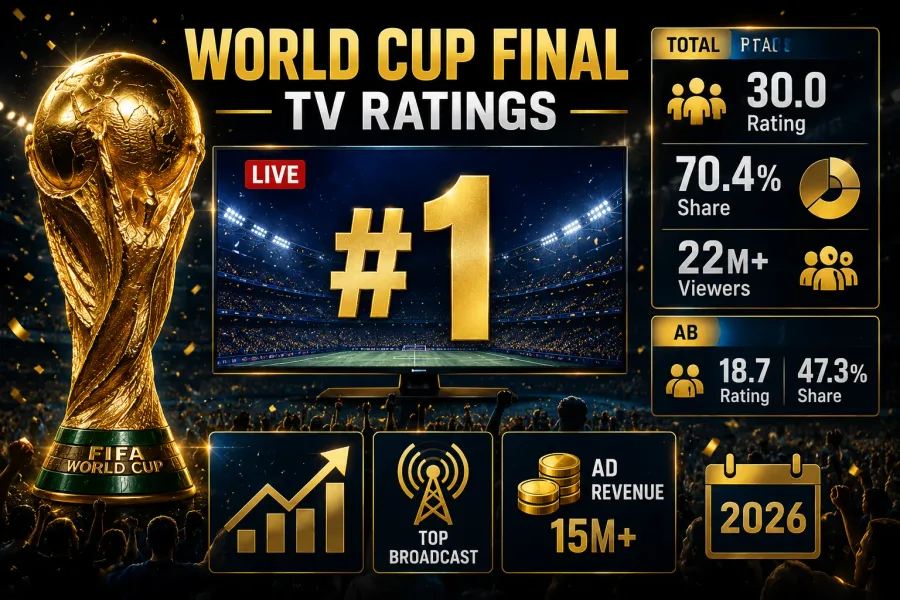
Turkish television audiences abandoned regular programming in unprecedented numbers on Sunday, July 19, 2026, as the FIFA World Cup final delivered a ratings performance that will be studied by media analysts for years to come. The match, broadcast live during prime time in Turkey, captured over 70% of the total viewing share, leaving domestic dramas, news bulletins, and entertainment shows struggling to attract even a fraction of their typical audiences. The ratings data, released by Turkey's official measurement panel, confirms the enduring power of live global sporting events in an era of fragmented digital media consumption.
The scale of the World Cup ratings triumph and what it means for Turkish broadcasters
The final match achieved a staggering 30 rating in the Total category, representing roughly 15 million viewers at its peak during the tense final minutes and extra time. For context, the most-watched Turkish drama series of 2026 typically averages between 8 and 12 rating points during the regular season. The AB demographic — Turkey's affluent, urban, and educated viewer segment — also delivered exceptional numbers, though slightly below the Total figures, indicating that football's appeal cut across all socioeconomic boundaries. The broadcaster holding the rights, which paid a substantial sum for the 2026 tournament package, saw its advertising revenue for a single evening surpass what many channels generate in an entire month.
Advertising slots during the pre-match buildup and halftime were reportedly sold at premiums of 500% to 700% above standard prime time rates, with major Turkish brands and global corporations competing for visibility during the most-watched television event of the year. Media buying agencies in Istanbul confirmed that the 30-second spot costs reached levels not seen since the peak of Turkey's television advertising boom in the mid-2020s. This financial windfall underscores why Turkish broadcasters aggressively compete for sports rights, even as global streaming platforms like Netflix and Disney+ continue to erode traditional TV's audience share for scripted entertainment.
Demographic breakdown and the rise of second-screen engagement
Detailed audience measurement data revealed a notable surge in female viewership compared to regular league matches, with women constituting approximately 45% of the total audience for the final. This demographic shift transforms how advertisers approach major sporting events, moving beyond traditionally male-targeted products to include household goods, family-oriented services, and lifestyle brands. Additionally, Turkey's Information and Communication Technologies Authority (BTK) reported a 40% spike in mobile data traffic during the match, as millions of viewers simultaneously engaged on social media platforms like X (formerly Twitter) and Instagram, creating a dual-screen experience that amplified the event's cultural impact beyond traditional ratings metrics.
How Turkish domestic productions strategically retreated and adapted to the ratings tsunami
Turkey's robust domestic television industry, which exports dramas to over 150 countries and generates billions in revenue, effectively conceded the evening to the World Cup final weeks in advance. Major broadcasters like Kanal D, Show TV, and Star TV rescheduled new episodes of their flagship series, opting instead for reruns or low-cost foreign film acquisitions. The strategic retreat proved wise: even Turkey's most popular news anchors, who typically dominate the 7 PM to 9 PM time slot, saw their ratings plummet by over 60% as the nation collectively tuned into the football. One veteran programmer, speaking anonymously to Reuters, described the decision-making process as 'simple survival math — you don't send a rowboat into a tsunami.'
However, the post-match window presented a unique opportunity. Channels that positioned compelling content immediately after the final whistle — primarily sports analysis programs and a blockbuster action film on a competing network — managed to retain a significant portion of the football audience. The sports commentary show that began within minutes of the trophy ceremony captured a 12 rating in Total, an exceptional figure for a studio-based program, proving that the World Cup's halo effect could extend beyond the match itself if broadcasters executed their transition strategies flawlessly. This post-event programming tactic is now being studied as a template for future major sporting events, including the 2028 Summer Olympics.
The economic calculus of counter-programming during mega-events
For Turkish television executives, the decision to avoid competing directly with the World Cup final involved complex financial calculations. Producing a new episode of a top-tier drama costs between 5 million and 10 million Turkish lira ($150,000 to $300,000), an investment that would have yielded virtually no return against the football juggernaut. Instead, channels redirected those budgets toward promoting their autumn 2026 lineups, using the World Cup's massive audience as a promotional platform. Trailers for new series aired during the match's commercial breaks reached more viewers than any dedicated marketing campaign could achieve, effectively subsidizing future programming through the World Cup's gravitational pull on audiences.
What Turkey's World Cup ratings reveal about global media consumption trends in 2026
Turkey's viewing patterns on July 19 offer a microcosm of global media dynamics in 2026. Despite years of predictions about the death of linear television, live events — particularly sports — continue to command audiences that on-demand platforms can only envy. While Netflix Turkey reported a predictable dip in streaming hours during the match, the company has itself invested heavily in live sports rights globally, tacitly acknowledging the format's irreplaceable value. The World Cup final's performance in Turkey, a country with a young, digitally native population and high smartphone penetration, demonstrates that appointment viewing is far from extinct when the stakes are high enough.
Measurement methodologies are also evolving to capture this hybrid reality. Turkey's Television Audience Research Committee (TİAK) has begun integrating data from digital platforms and connected TV devices into its official ratings reports, though the July 19 figures primarily reflect traditional panel-based measurement. Industry insiders estimate that an additional 15% to 20% of viewership occurred through legal streaming services and mobile applications, suggesting the true audience for the final may have been even larger than the already historic numbers indicate. This data gap has reignited debates within Turkey's advertising industry about how to accurately price and package cross-platform campaigns around tentpole events.
The geopolitical and cultural dimensions of football viewership in the Turkish market
Football occupies a unique space in Turkish society, transcending political divisions and serving as a rare unifying force. The World Cup final's massive ratings reflect not just sporting enthusiasm but also a form of collective national participation in a global cultural moment, even when Turkey's national team is not involved. Media sociologists at Istanbul's Bilgi University have noted that major football events temporarily reverse the fragmentation of Turkey's media landscape, bringing together audiences that normally self-segregate into ideologically aligned news channels and entertainment platforms. This phenomenon has implications for advertisers seeking broad-based campaigns and for policymakers concerned with social cohesion in an increasingly polarized media environment.
Strategic lessons for broadcasters and advertisers in the post-World Cup media landscape
As Turkish television enters the second half of 2026, the World Cup final's ratings performance offers clear strategic directives. First, live sports rights remain the most reliable tool for aggregating mass audiences in an era of infinite choice. Second, the financial model of free-to-air broadcasting — dependent on advertising revenue from shared cultural moments — still functions when those moments are sufficiently compelling. Third, the integration of social media and second-screen strategies is no longer optional but essential for maximizing the value of these rare high-attention events. Turkish broadcasters who successfully executed real-time social media engagement during the final saw significantly higher brand recall scores in post-event surveys.
Looking ahead to the 2026-2027 television season, programmers are already applying these insights. Several Turkish networks have announced increased investments in live event programming, from music awards to New Year's Eve specials, seeking to replicate the communal viewing experience that made July 19 a landmark day for the industry. Meanwhile, advertisers are recalibrating their annual budgets to reserve substantial contingency funds for opportunistic spending around unplanned but high-impact events, recognizing that the old model of fixed quarterly allocations cannot capture the outsized returns generated by cultural phenomena like the World Cup final.
The future of ratings measurement and audience analytics in Turkey's evolving media ecosystem
The 2026 World Cup final has accelerated ongoing discussions about modernizing Turkey's television audience measurement infrastructure. Current panel-based systems, while statistically robust, struggle to capture out-of-home viewing in cafes, restaurants, and public squares where millions of Turks watched the match collectively. TİAK has announced plans to pilot passive measurement technologies using audio fingerprinting through mobile devices, a method that could provide more granular data about communal viewing patterns. For the global advertising agencies operating in Turkey's $2 billion television advertising market, these methodological improvements cannot come soon enough, as the gap between measured and actual viewership for mega-events represents significant undervalued commercial inventory.
