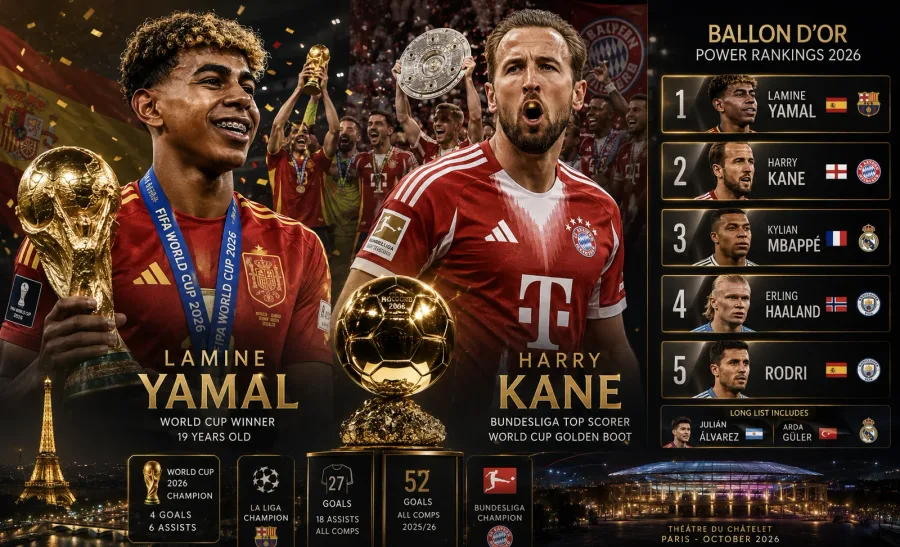
The 2026 Ballon d'Or race represents the most wide-open contest in two decades, finally free from the duopoly of Lionel Messi and Cristiano Ronaldo. As the football world turns its eyes to the October ceremony in Paris, a fascinating narrative has emerged: the teenage World Cup winner against the relentless goal-scoring machine. Lamine Yamal, Spain's 19-year-old prodigy, has captured the imagination of fans worldwide by leading his nation to glory on the biggest stage. Yet, standing in his way is Harry Kane, whose record-breaking consistency for Bayern Munich and England has set a new standard for individual excellence. This is not just a competition between two players; it is a philosophical battle over what truly defines the best footballer on the planet.
The World Cup weight: Yamal's historic summer in America
The 2026 FIFA World Cup, hosted across the United States, Canada, and Mexico, will be remembered as the tournament where Lamine Yamal announced himself as the heir to football's throne. At just 19 years old, the Barcelona winger played with a maturity that belied his age, scoring four goals and providing six assists, including a decisive moment in the final that secured Spain's second World Cup title. His performances were not just statistically impressive; they were culturally seismic, drawing comparisons to Pelé's 1958 breakthrough. In World Cup years, the award has historically favored the tournament's standout performer, a precedent that gives Yamal a significant edge in the eyes of many voters.
However, the Ballon d'Or is not solely a tournament prize; it evaluates performance over the entire calendar year. While Yamal lifted the La Liga trophy with FC Barcelona, the club's quarter-final exit in the UEFA Champions League remains a blemish on his otherwise stellar season. The Champions League is often considered the highest level of club football, and a deep run there is typically a prerequisite for the award. Yamal's supporters argue that his World Cup heroics transcend any club shortcomings, but critics point to the lack of a European club title as the one vulnerability in his otherwise flawless candidacy. The voting body, comprised of journalists from the top 100 FIFA-ranked nations, will have to decide how much weight to assign to a seven-game tournament versus a ten-month club season.
Historical precedents for World Cup winners
Football history strongly favors World Cup champions in Ballon d'Or voting. From Ronaldo in 2002 to Fabio Cannavaro in 2006 and Luka Modric in 2018, the tournament's most influential player almost always claims the prize. Yamal's case is nuanced, however, as Spain's triumph was a collective effort, with teammates like Rodri and Pedri also delivering world-class performances. The risk of vote-splitting is real. Yet, Yamal's status as the team's talisman—the player who created moments of magic out of nothing—makes him the most likely beneficiary of Spain's success. His youth adds a narrative layer that voters often find irresistible: the coronation of a new king.
Kane's statistical dominance and the trophy dilemma
Harry Kane's 2025-26 season has been a masterclass in consistency and lethal finishing. The Bayern Munich striker won his second consecutive Bundesliga Golden Boot, netted over 50 goals in all competitions for the third time in his career, and led his club to a domestic double. In the Champions League, his 12 goals propelled Bayern to the final, though a defeat to Real Madrid denied him a coveted European club title. On the international stage, Kane won the World Cup Golden Boot with five goals, despite England's quarter-final exit. His statistical output is, by any measure, the best in world football for the 2025-26 season.
The central tension in Kane's candidacy is the absence of a major trophy. Despite his individual brilliance, his trophy cabinet for the year lacks the two most prestigious titles: the Champions League and the World Cup. This has been a recurring theme in his career, and it is the primary argument used against him by Yamal's proponents. A pure statistical analysis favors Kane, but the Ballon d'Or is a subjective award, often swayed by narrative and the 'clutch' factor. Voters must grapple with a difficult question: can a player be considered the world's best if he did not win the most important matches of the year? Kane's supporters argue that his consistency is a form of greatness in itself, but history suggests the trophy lift carries more weight.
A closer look at Kane's record-breaking numbers
The sheer volume of Kane's output is staggering: a goal contribution every 65 minutes, a club-level goal average exceeding 1.0 per game, and the distinction of being the first Englishman to win a World Cup Golden Boot since Gary Lineker in 1986. These are not just good numbers; they are historic. Yet, the Ballon d'Or has rarely been kind to pure goal-scorers without silverware. The award's recent history favors players who have defined the biggest moments, a metric where Yamal's World Cup final assist carries more emotional and symbolic weight than any single goal Kane scored in the tournament. The statistical argument is powerful, but it may not be powerful enough to overcome the allure of a world champion.
The global contenders: Mbappe, Haaland, and the dark horses
Beyond the Yamal-Kane duopoly, a host of superstars are vying for a place on the podium. Kylian Mbappe, now the undisputed leader of Real Madrid, won the Champions League and La Liga, scoring 45 goals in the process. His World Cup campaign with France ended in the semi-finals, but his club season was virtually flawless. Erling Haaland secured his fourth consecutive Premier League Golden Boot with Manchester City, yet Norway's failure to qualify for the World Cup leaves a gaping hole in his resume. The award's criteria heavily penalize players who miss the sport's biggest tournament, effectively ruling Haaland out of the top spot.
In the midfield, Spain's Rodri presents a compelling, if understated, case. He was named Player of the Tournament at the World Cup and was the anchor for a Manchester City side that won the Premier League. His dual success at both club and international levels makes him a unique candidate. From South America, Argentina's Julian Alvarez has emerged as a dark horse, winning the Copa America and playing a pivotal role in the Champions League. These players, while unlikely to win, will heavily influence the final ranking by drawing votes away from the top two, making the final tally a complex puzzle of regional and stylistic preferences.
The shifting narratives of Mbappe and Haaland
The post-Messi/Ronaldo era was supposed to be defined by Mbappe and Haaland, but 2026 has complicated that narrative. Mbappe has the club trophies but lacked the definitive World Cup moment, while Haaland's international absence is a chronic disadvantage. Yamal's sudden ascension has disrupted their duopoly, creating a new, younger focal point for the football world. This shift is not just about one award; it signals a potential changing of the guard, where a player born in 2007 is now the benchmark for greatness. For Mbappe and Haaland, the 2026 Ballon d'Or is a missed opportunity, a moment seized by a teenager who has redefined the timeline of football stardom.
A view from Turkey: Arda Güler and the local impact
For Turkish football fans, the 2026 Ballon d'Or race is watched with a mix of global excitement and local pride, centered on Real Madrid's Arda Güler. The 21-year-old playmaker has completed his most productive season yet, becoming a key rotation player for the European champions and earning plaudits for his creativity and vision. While a World Cup appearance was not possible for Turkey, Güler's performances in La Liga and the Champions League have placed him firmly on the radar for a top-30 nomination. The possibility of a Turkish player being listed among the world's elite is a source of immense national pride and a testament to the country's growing football infrastructure.
The debate within Turkey mirrors the global conversation, with sports commentators and fans divided between Yamal's romantic triumph and Kane's statistical perfection. Turkish football legends, in televised discussions, have largely favored the narrative of the World Cup winner, arguing that football's ultimate prize must define its ultimate individual award. However, a significant minority emphasizes the importance of season-long consistency, pointing to Kane's numbers as the truest measure of a player. This local discourse reflects a deeper, universal tension in how we evaluate sporting greatness, making the 2026 Ballon d'Or a truly global talking point that resonates from Istanbul to Buenos Aires.
Arda Güler's rising star and future prospects
Arda Güler's trajectory suggests that his best Ballon d'Or chances lie in the future. His technical ability and football intelligence are undeniable, and his integration into Real Madrid's first team has accelerated his development. For Turkish football, his presence in these conversations is a victory in itself, breaking barriers and inspiring a new generation. As the 2026 award ceremony approaches, Güler's name on the longlist would mark a historic achievement for Turkey, a sign that the nation is producing talents capable of competing on the sport's most glamorous stage. The focus for Güler will now shift to the 2026-27 season, where a leading role at Real Madrid could propel him from a promising talent to a genuine Ballon d'Or contender.
