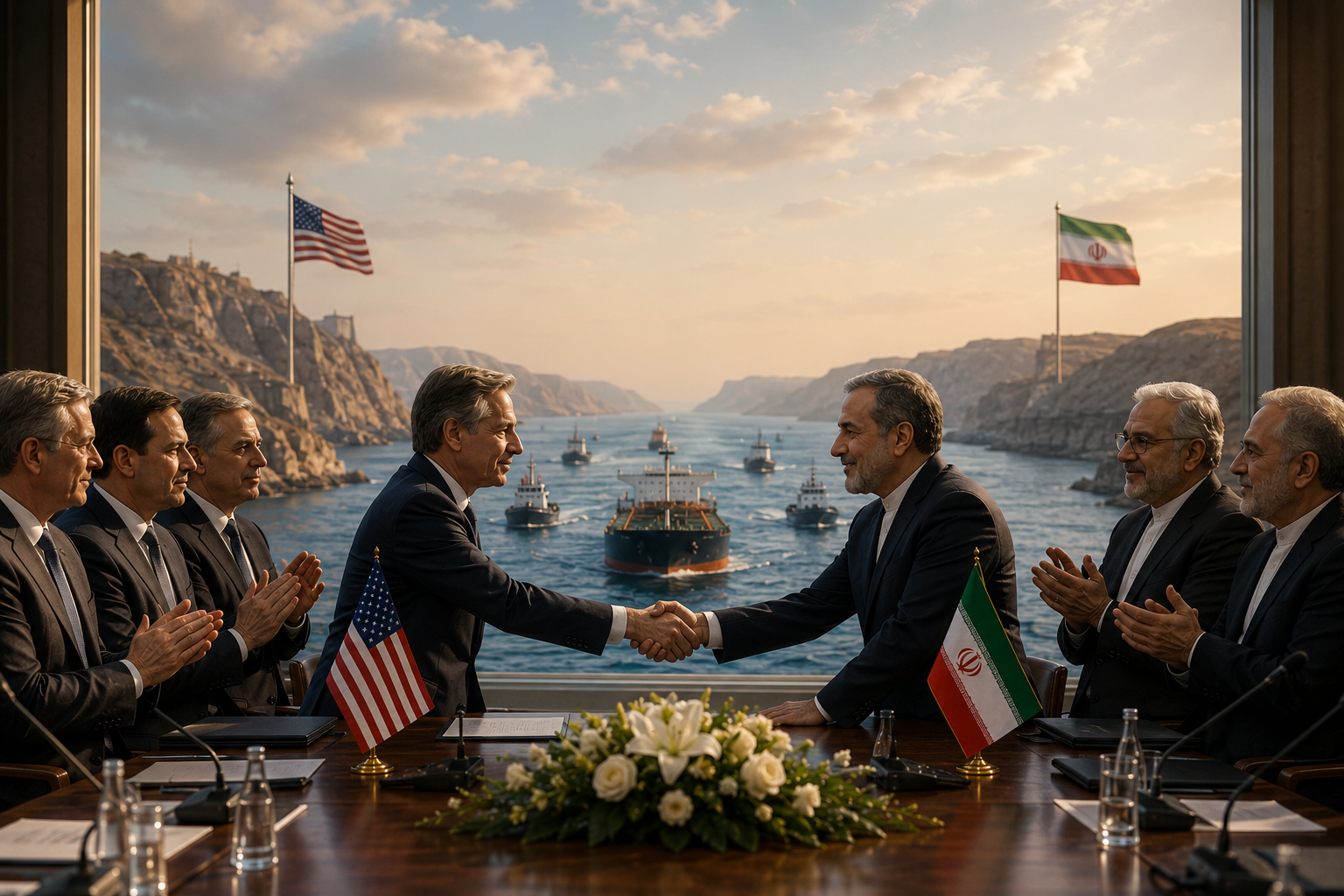
The world watched with cautious relief on June 18, 2026, as Washington and Tehran announced an initial agreement to halt a brutal 18-month war that had set the Middle East ablaze and thrown the global economy into disarray. The deal, brokered through back-channel talks in Oman, promises an immediate ceasefire and the phased reopening of the Strait of Hormuz—the narrow waterway through which nearly 21 million barrels of oil pass daily, accounting for over 20% of global consumption. But even as diplomats hailed the breakthrough, critical disputes over Iran’s nuclear program, ballistic missile arsenal, and support for regional militias were deliberately deferred, leaving the path to lasting peace as fragile as the truce itself.
The Anatomy of a Breakthrough Deal
From Near Collapse to a Fragile Truce
The road to June 18 was paved with failed ceasefires and catastrophic miscalculations. When the conflict ignited in late 2024—triggered by a U.S. precision strike on Iran’s Fordow enrichment bunker—few predicted its rapid spiral into a full-scale regional war. Iran’s Revolutionary Guards immediately retaliated, launching over 300 ballistic missiles at critical oil infrastructure in Saudi Arabia and the UAE, and mining the Strait of Hormuz. By January 2025, the world’s most vital energy chokepoint was effectively closed, sending Brent crude prices from $82 to $158 per barrel in a matter of weeks.
The human toll mounted quickly: conservative United Nations estimates put the death toll at 48,000, including civilians in Tehran, Riyadh, and Tel Aviv who bore the brunt of long-range strikes. Behind the scenes, Oman and Qatar shuttled messages between the adversaries. A critical shift came in May 2026, when neither side could sustain the economic bleeding. Iran’s currency had lost 70% of its value against the dollar, and consumer unrest in the U.S. over $5-a-gallon gasoline threatened midterm elections. The initial deal thus reflects mutual exhaustion rather than a meeting of minds.
Economic Lifeline: The Strait of Hormuz Reopens
Oil Markets Breathe Again, But Uncertainty Lingers
The centerpiece of Thursday’s announcement is the phased resumption of traffic through the Strait of Hormuz, a 21-mile-wide passage that daily funnels 21 million barrels of crude and condensate. Under the terms, a joint U.S.-Iranian maritime committee will oversee mine clearance and inspection protocols, with the first commercial tankers expected to transit as early as June 30. The International Energy Agency (IEA) immediately revised its 2026 global growth forecast upward by 0.4 percentage points, projecting that oil could fall back to $95 per barrel by September if supply stabilizes.
Yet shipping insurers remain wary. The deal does not bind Iran’s allied Houthi forces in Yemen, who have attacked Red Sea shipping with anti-ship missiles throughout the war. “The Strait may be open, but the threat of proxy disruption is palpable,” warned a senior Lloyd’s of London underwriter. Moreover, the reopening agreement hinges on the U.S. lifting secondary sanctions on Iranian oil exports—a move that faces stiff opposition in Congress. Economists caution that even a partial return of Iran’s 2.5 million barrels per day to the market could be disrupted if the agreement unravels over its many unresolved clauses.
The Unfinished Business: Nuclear Ambitions and Regional Proxies
Iran’s Enrichment Stockpile and the Militia Question
What the initial deal conspicuously omits is a comprehensive nuclear settlement. When the war started, Iran was enriching uranium to 60% purity—a short technical step from weapons-grade 90%—and its stockpile had grown to an estimated 450 kilograms, according to IAEA reports. The agreement freezes enrichment at current levels but provides no timeline for reducing it or granting the IAEA the unfettered access demanded by inspectors. Israeli Prime Minister Naftali Bennett wasted no time denouncing the deal as “a capitulation that leaves the genie of a nuclear Iran uncorked,” threatening unilateral military action if the next phase of talks does not dismantle enrichment sites.
Equally troubling is the status of Iran’s network of proxy forces. Hezbollah in Lebanon, Kata’ib Hezbollah in Iraq, and the Houthis in Yemen have all been emboldened by the war, receiving advanced drone and cruise missile technology. The deal calls for a “regional dialogue” on non-state actors but sets no mechanism for disarming or restraining them. For U.S. allies in the Gulf, this is a red line: “We cannot accept a ceasefire that allows Iran to continue arming the very groups that struck our capital with ballistic missiles,” said a senior Emirati official on condition of anonymity.
Global Reactions and the Road Ahead
Allies, Adversaries, and the UN’s Watchful Eye
International response split along predictable fault lines. China, which lost an estimated $180 billion in trade from the Strait closure, hailed the accord as “a victory for diplomacy.” India, similarly dependent on Middle East crude, dispatched its foreign minister to Tehran and Washington to offer logistical support for the peace process. Russia, eager to see higher oil prices that funded its own war effort, gave a tepid welcome, noting that the deal “must be supported by concrete actions.”
The United Nations Security Council scheduled an emergency session for June 19 to discuss a binding resolution endorsing the ceasefire. However, the unresolved nuclear and proxy issues threaten to derail long-term peace. “We’ve stopped the shooting, but we haven’t begun to solve the reasons the shooting started,” a European diplomat in Geneva told reporters. The initial agreement sets a 90-day deadline for negotiating a permanent settlement, a window that pessimists see as far too narrow for the compromise required.
As the fragile truce takes hold, the world faces a sobering truth: the deal that reopened the Strait of Hormuz may have saved the global economy, but it also handed Iran a strategic lifeline without neutralizing the threats that plunged the Middle East into its deadliest conflict in decades. The next three months will determine whether this is a genuine pivot toward peace or simply an interlude before an even fiercer storm. Will the negotiators turn this initial deal into a lasting peace, or are we witnessing merely the eye of the hurricane? The answer will define the 21st century’s most volatile region.
