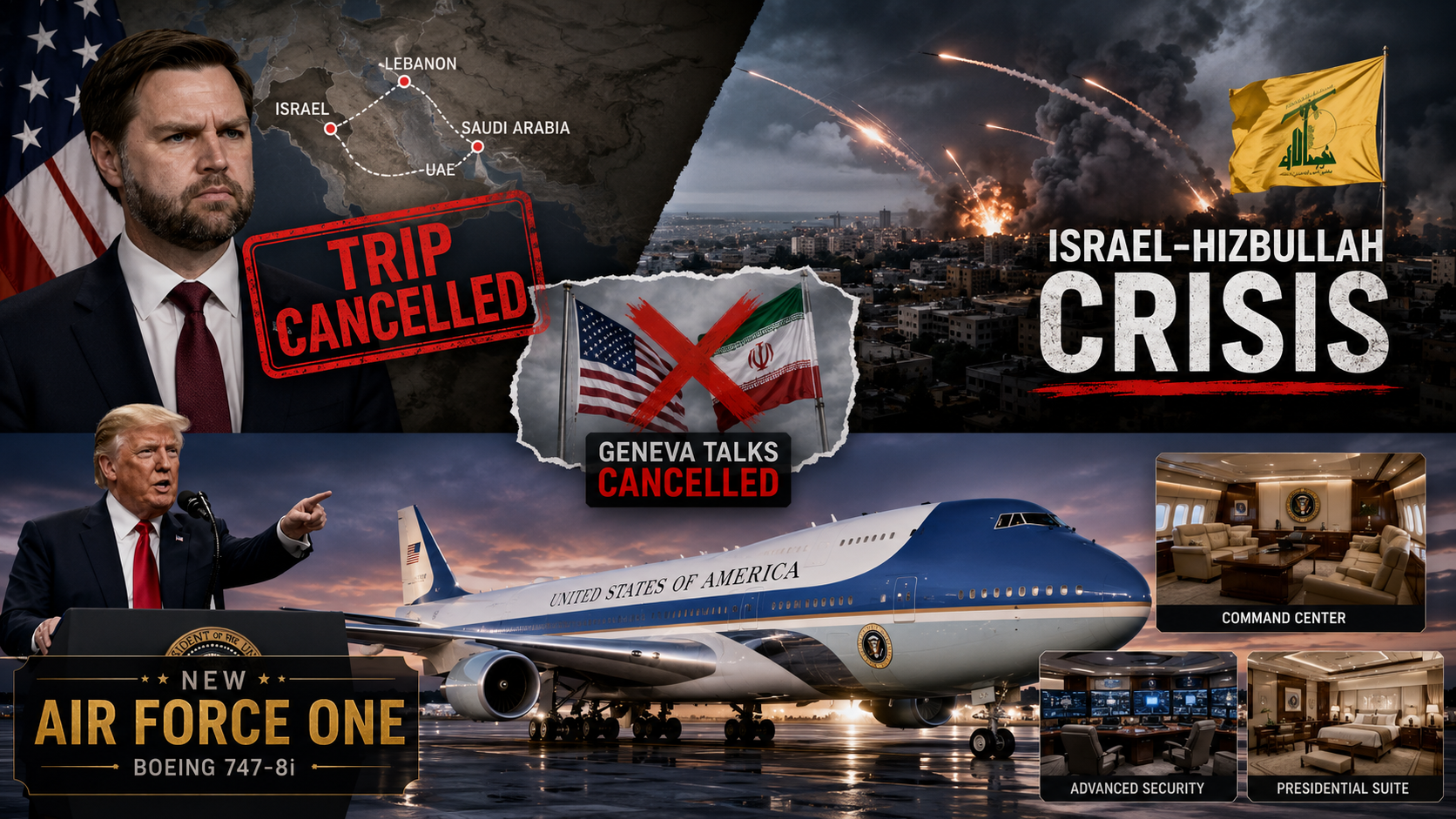
On Friday June 19, 2026, two seismic developments rocked the Trump administration: Vice President JD Vance’s Middle East tour was abruptly grounded by intensifying Israel-Hezbollah clashes, and President Trump unveiled the new Air Force One – a converted Boeing 747-8i originally built for Qatar’s royal family. These dual crises expose the volatile intersection of Middle East policy and White House symbolism, testing the administration’s foreign policy agility and domestic messaging.
Vance Trip Cancelled: A Diplomatic Mission Derailed by Rocket Fire
The vice president was scheduled to visit Israel, Saudi Arabia, and the UAE on a five-day mission aimed at shoring up the Abraham Accords framework, but spiraling violence along the Israel-Lebanon border forced an abrupt cancellation. The White House cited credible security threats after Hezbollah launched more than 200 rockets and several drone swarms within 72 hours, leading to at least 45 civilian casualties. Compared to the fragile truce brokered in 2025, the current escalation marks the deadliest cross-border exchange since the 2006 war.
Inside the Decision: Real-Time Threat Assessment
According to senior defense officials, the final straw came when Israeli intelligence intercepted a Hezbollah plot to target the very airbase where Air Force Two was expected to land. A simultaneous drone attack on Haifa’s port, which narrowly missed a US-flagged cargo ship, elevated the risk beyond acceptable thresholds. The cancellation not only scuttled high-level talks on energy cooperation and missile defense, but also sent a chilling message to regional allies about Washington’s ability to guarantee security during crises. The episode has sparked internal debate over whether the administration’s containment strategy toward Iran is actually working.
Iran Nuclear Talks Collapse: Lebanon Flames Extinguish Geneva Hopes
Hours after Vance’s trip was called off, the State Department confirmed that an informal US-Iran meeting scheduled in Geneva had been cancelled, directly citing the Lebanon hostilities. The Swiss-mediated dialogue was viewed as the most promising backchannel since the 2025 impasse, when Iran resumed 20% uranium enrichment. “We cannot sit at a table while rockets rain down on civilians,” a department spokesperson stated. Analysts argue that Tehran’s greenlighting of Hezbollah’s offensive was a deliberate move to bury any diplomatic off-ramp, signaling the ascendancy of hardliners who reject engagement with the West.
Market Jitters: Oil Prices Spike as Diplomacy Falters
The diplomatic rupture triggered immediate market fallout. Brent crude surged from $87 to $94 a barrel on June 19, the highest level in eight months, as traders priced in prolonged instability. The White House responded by announcing a planned drawdown from the Strategic Petroleum Reserve and expediting calls with Gulf producers to boost output. The economic sting underscores how the canceled Vance mission could have cushioned the blow through pre-negotiated energy supply guarantees. With inflation still a sensitive issue in the 2026 midterm campaign, the administration faces political peril if pump prices spike further.
The New Air Force One: From Qatari Luxury to Command Center
While foreign policy erupted, President Trump seized the domestic spotlight with the long-awaited reveal of the new Air Force One. After scrapping the over-budget Boeing VC-25B program in 2025 due to cost disputes, the administration acquired a never-delivered Boeing 747-8i originally commissioned by the Emir of Qatar. Trump touted the savings: “We repurposed a plane that was collecting dust and saved the American taxpayer over $2 billion.” The jet now features a revamped blue-and-white livery, a hardened electromagnetic pulse shield, and upgraded secure communications suites.
Luxury Meets Power: Controversy Over Cabin Design
The aircraft’s interior transformation has drawn sharp scrutiny. The original configuration included gold-plated fixtures and a royal majlis lounge for the Qatari royals; the remodel retains a more austere presidential office, conference room, and medical suite, but critics note that some gilded elements remain visible in the executive bedroom. “Flying in a hand-me-down from a Gulf monarch undercuts the dignity of the office,” said a former protocol chief. Supporters counter that it exemplifies Trump’s deal-making ethos. The plane is scheduled to make its maiden official voyage to the G7 summit in Tokyo next month, where its symbolism will be judged on the world stage.
A Stress Test for Trump’s Foreign Policy Doctrine
The twin events of June 19 lay bare the inherent contradictions in Trump’s “America First” framework. While the new Air Force One projects cost-cutting independence, the escalating Lebanon crisis forces the administration to confront the messy realities of Middle East entanglement. White House insiders hint that a scaled-down, covert Vance trip may still occur within weeks, and intelligence backchannels with Iran remain open. But for now, the president must navigate a landscape where diplomatic retreat and military brinkmanship are increasingly intertwined.
What do you think: does the revamped Air Force One strengthen presidential prestige, or does it signal a symbolic downgrade? And will the deepening Lebanon crisis push the US toward an unavoidable military intervention? Share your perspective.
