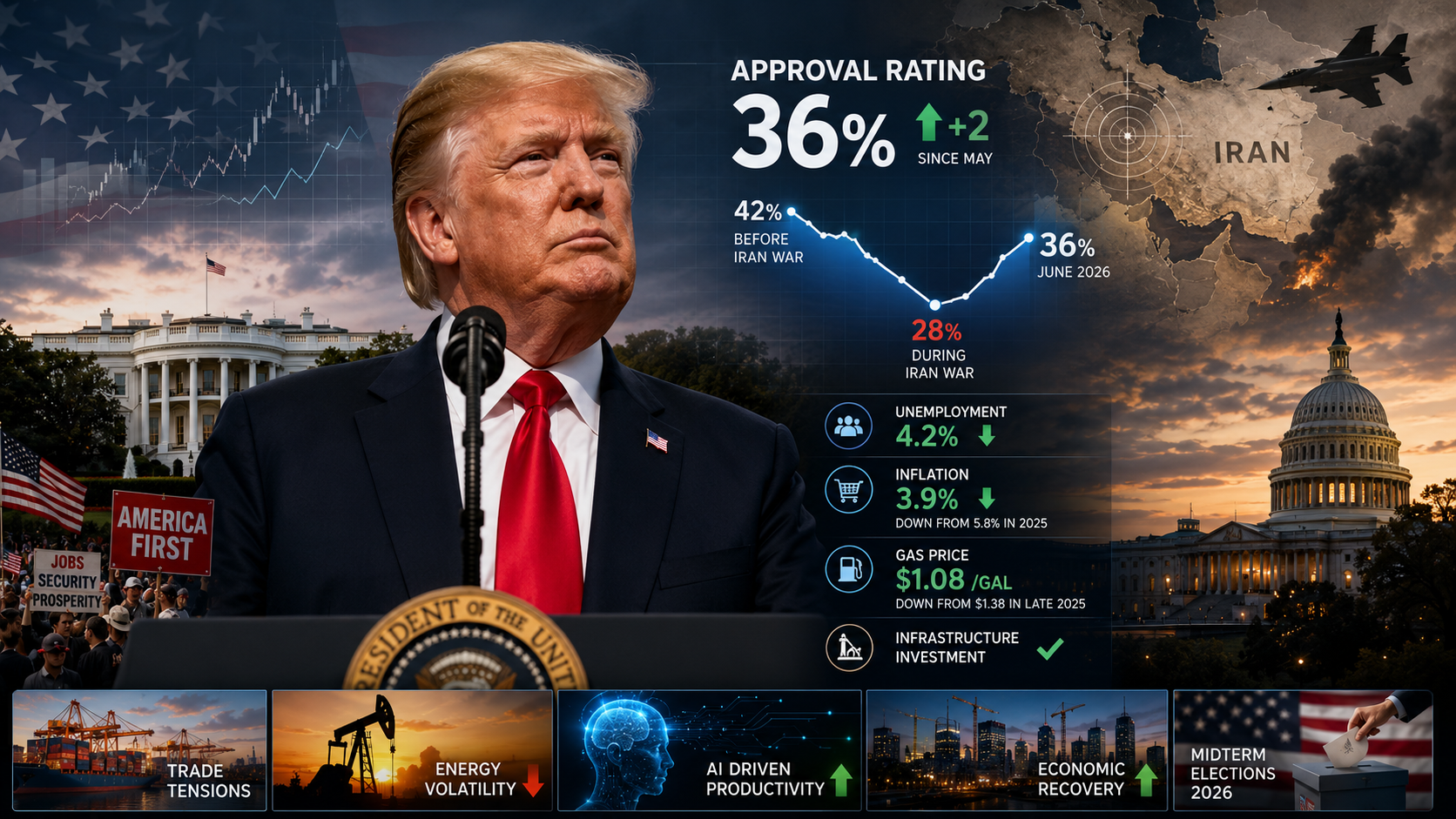
What the Latest Poll Reveals: A Modest but Meaningful Uptick
Data emerging in the first weeks of 2026 paint a complex picture for President Trump. The Reuters/Ipsos poll released June 17 shows 36% of Americans approve of his performance—a 2-point gain from May, when the figure stood at 34%. Yet the president’s numbers remain firmly in the shadow of the short but jarring war with Iran that reshaped his second term.
Voter Behavior Behind the Numbers
Demographic breakdowns indicate that while the Republican base remains loyal, independent voters continue to swing. During the Iran conflict that began in 2025, approval dipped as low as 28%. The war officially wound down in the first quarter of 2026, triggering a gradual recovery, but the pre-war benchmark of 42% remains distant. Sub-indices on the economy and foreign policy still show limited healing.
The Pre-War Era: Anatomy of a Lost Peak
At the start of his second term in January 2025, Trump’s approval hovered comfortably in the 41–43% band. Trade reforms and energy independence pledges gave him momentum—until military operations against Iran triggered the first major confidence shock. Surging oil prices rattled domestic markets and international criticism added political headwinds.
Conflict’s Toll: Not Just Military, but Political
Though the Iran operation was relatively brief and relied on limited ground engagement thanks to U.S. technological superiority, public ‘war fatigue’ continues to reverberate at the ballot box. Serial Reuters/Ipsos surveys show 62% of Americans believe the country is on the wrong track. So while 36% approval offers a fractional reprieve, it also signals that winning back independents will be slower than the White House would like.
Why the Numbers Are Crawling Upward
This 2-point gain is no accident. The White House’s ‘Rebuild America’ package has fast-tracked infrastructure projects since April, pushing the unemployment rate down to 4.2% in May 2026 and bringing inflation from 5.8% last year to 3.9%. Coupled with the durable ceasefire with Iran, the easing of uncertainty has generated cautious public relief.
The Silent Recovery’s Hero: The Economy?
For voters, everyday costs still dominate. In the final quarter of 2025, gasoline prices hit $1.38 per liter, fueling peak discontent. By summer 2026, the average price has fallen to $1.08, giving middle-class families a slight budgetary breather. This tangible improvement is the strongest explanation for the president’s tentative rebound.
Obstacles Ahead: Congress, Midterms, and a Divided Society
The real challenge for the Trump administration is navigating the November 2026 midterms while holding both chambers of Congress. Republicans currently cling to a fragile House majority and a two-seat Senate edge. Every percentage-point shift in approval could directly tip the balance in toss-up states like Pennsylvania, Arizona, and Georgia.
A Rising Opposition and Strategic Pressure
Democrats continue to hammer Trump for not managing the post-war recovery quickly enough. A newly formed ‘Beyond the Front’ coalition is rallying young voters by emphasizing that the war’s cost has exceeded $120 billion—money they argue should have been spent at home. Yet a splintered opposition structure gives the president maneuvering room; the absence of a clear rival is, for now, an asset.
Outlook: Fragile Optimism
Holding at 36% as 2026’s second half begins can be read as a ‘starting signal’ for a broader recovery. However, political analysts insist that stable approval above 38% for at least two consecutive quarters is necessary to alter the narrative. The biggest risk remains geopolitical fragility. Implementation of the Iran deal, ongoing trade talks with China, and the increasing frequency of climate disasters could upend this delicate equilibrium overnight. Trump’s real test is demonstrating a shift from austerity to growth that voters can feel. Without that, today’s modest poll bump may evaporate into a fleeting hope before the midterms.
Voters’ Bottom Line: Wait and See
In the open-ended section of the Reuters/Ipsos survey, a significant share of respondents wrote some variation of ‘I support the president but I need to see more results.’ That sentence captures the mood of America in 2026: weary but not entirely closed to tentative hope. Economic metrics and concrete foreign-policy moves will dictate the approval trajectory in the coming months. For now, the public has given the White House not credit, but an advance.
