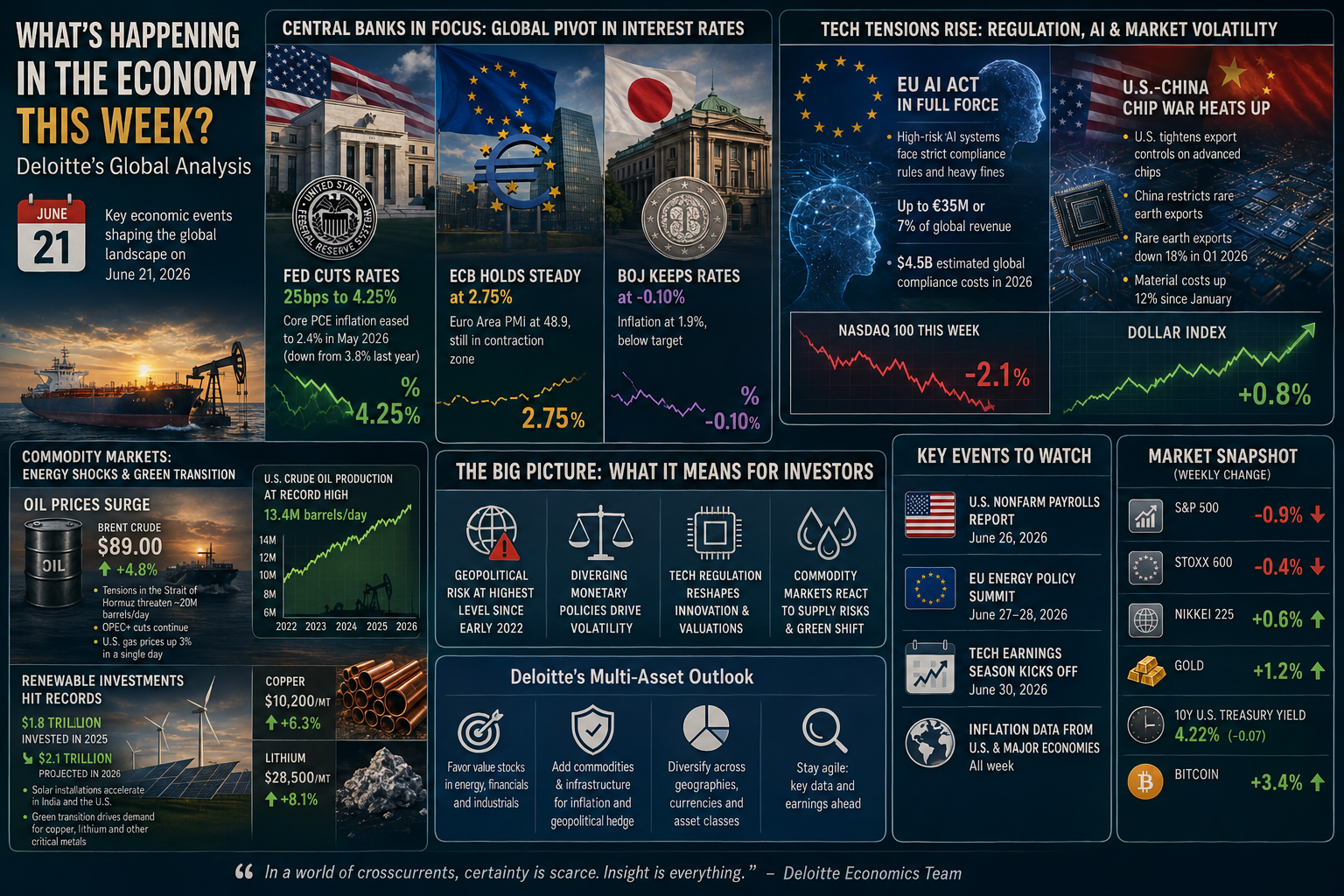
In the ever-shifting landscape of global economics, a single week can rewrite the narrative. From Washington to Tokyo, central banks are tearing up their playbooks, while a transatlantic regulatory crackdown on artificial intelligence is redrawing the boundaries of innovation. Meanwhile, commodity markets are caught between geopolitical firestorms and the inexorable march of green energy. Deloitte’s team of economists has been dissecting every data release, policy shift, and market tremor to bring you the story behind the headlines. Here’s what’s shaping the world economy this week, June 21, 2026.
Central Banks in the Spotlight: A Global Pivot on Interest Rates
The Federal Reserve concluded its June meeting with a 25-basis-point rate cut, bringing the federal funds rate down to 4.25%. This marks a decisive shift from the aggressive tightening that dominated 2023 through early 2025. Deloitte economists point to the core Personal Consumption Expenditures (PCE) price index, which dipped to 2.4% in May 2026—down from 3.8% a year ago. “The Fed is walking a tightrope,” says Dr. Michael Horan, Chief Economist at Deloitte. “Cutting too fast could reignite inflation, but holding too long risks tipping the economy into a recession.” The labor market, however, remains stubbornly tight: the unemployment rate held at 3.6%, with 220,000 new jobs added in May. That resilience gives the Fed cover to move cautiously.
The Fed’s Balancing Act
But behind the headline numbers, cracks are appearing. Consumer spending grew just 0.3% in April, and credit card delinquencies have risen to their highest level since 2010. Deloitte’s models suggest a 35% probability of a mild recession by early 2027 if the Fed pauses now. The message to investors? Brace for volatility, but don’t flee equities entirely.
ECB and Bank of Japan Follow Divergent Paths
Across the Atlantic, the European Central Bank held rates at 2.75% but signaled in its forward guidance that a cut could come as early as September. The eurozone economy is barely growing: the composite PMI printed at 48.9 in May, lingering in contraction territory. Deloitte’s Frankfurt-based analyst, Lena Vogel, notes, “Germany’s industrial output contracted by 1.2% in Q1, and business confidence is wavering. The ECB has little choice but to remain accommodative.” Meanwhile, the Bank of Japan defied market expectations by maintaining its negative interest rate of -0.1%, citing tepid wage growth of just 1.2% year-on-year. Tokyo’s inflation stands at 1.9%, below the 2% target. The yen’s slide to ¥152 per dollar is boosting export competitiveness but fanning fears of imported inflation. This divergence in monetary policy is sending ripples through currency markets, with the dollar index climbing 0.8% for the week.
Tech Tensions Escalate: Regulation, AI, and Market Ripples
This month’s full implementation of the EU AI Act is the talk of Silicon Valley. The landmark legislation requires companies deploying high-risk AI systems to submit rigorous risk assessments, with penalties reaching €35 million or 7% of global revenue. Deloitte estimates that compliance costs for AI developers could hit $4.5 billion globally in 2026, and that 60% of smaller AI startups lack the resources to fully adapt. The regulatory squeeze has already contributed to a 2.1% drop in the Nasdaq 100 this week, as investors reassess tech valuations.
EU’s AI Act Bites Down
“This isn’t just a European issue,” explains Dr. Horan. “Multinationals can’t afford to have separate AI stacks for different regions. The EU’s rules are becoming a de facto global standard.” Google and Microsoft have already announced internal AI ethics boards to comply, but the uncertainty is chilling innovation in areas like generative AI for healthcare.
US-China Chip War Intensifies
On the geopolitical front, the semiconductor tug-of-war shows no sign of easing. The current US administration doubled down on export controls first imposed in 2022, restricting advanced chips and manufacturing equipment to China. In retaliation, Beijing limited rare earth element exports—down 18% in the first quarter of 2026—which has driven up material costs by 12% since January. Deloitte’s supply chain specialist warns that these tit-for-tat measures are balkanizing global supply chains, with long-term consequences for everything from smartphones to electric vehicles.
Commodity Markets: Energy Shocks and the Green Transition
Brent crude surged 4.8% this week to $89 per barrel after renewed tensions in the Strait of Hormuz threatened transit of nearly 20 million barrels per day. Deloitte’s energy desk highlights that OPEC+ output cuts remain in place, while US Strategic Petroleum Reserve levels hover near 40-year lows. The immediate effect: gasoline prices in the US jumped 3% overnight, rekindling inflation anxieties that had been easing.
Oil Prices Surge on Geopolitical Fears
Yet supply-side pressures are partly offset by record US shale production, which reached 13.4 million barrels per day in June. “The world is awash in oil, but it’s the perception of scarcity that moves markets,” says Deloitte’s commodity strategist. This volatility is a stark reminder that fossil fuels still hold sway over global inflation metrics.
Renewable Investments Hit New Records
In a powerful counter-narrative, global investment in renewable energy is shattering records. According to IRENA data cited by Deloitte, $1.8 trillion flowed into renewables in 2025, and the firm projects $2.1 trillion for 2026—a milestone that would mark a permanent shift in energy economics. Solar installations in India and the US are accelerating, driven by generous tax credits and plummeting panel costs. “The green transition is no longer a future bet; it’s today’s growth story,” notes Dr. Horan. Yet the irony is that this very transition is adding near-term demand for metals like copper and lithium, creating fresh supply bottlenecks.
The Big Picture: What These Trends Mean for Investors
Synthesizing these cross-currents, Deloitte’s multi-asset team recommends a cautious but opportunistic stance. With interest rate paths diverging and tech regulation tightening, a traditional 60/40 portfolio may underperform due to bond market volatility. Instead, they advocate rotating into value stocks in sectors like energy and financials, while adding commodities and infrastructure assets to hedge against inflation and geopolitical risk.
A Multi-Asset Strategy for Uncertain Times
Geopolitical risk, as measured by the firm’s proprietary index, is at its highest since the early days of the Ukraine conflict in 2022. “You can’t invest without a geopolitical map anymore,” warns Deloitte’s strategist. Gold, for instance, has gained 9% year-to-date as a safe haven. The bottom line: diversification across geographies, currencies, and asset classes is essential. The coming weeks will be critical, with the next US payrolls report, the EU summit on energy policy, and earnings season for tech giants all on the horizon.
As these forces converge, the only certainty is uncertainty. Whether you’re a seasoned trader or a policy wonk, the data Deloitte has laid out demands attention. The week ahead may well hinge on the next inflation print from the US, the next earnings call from a tech giant, or the next barrel of oil that crosses a contested strait. Stay informed, stay agile, and stay tuned to our weekly deep dives.
