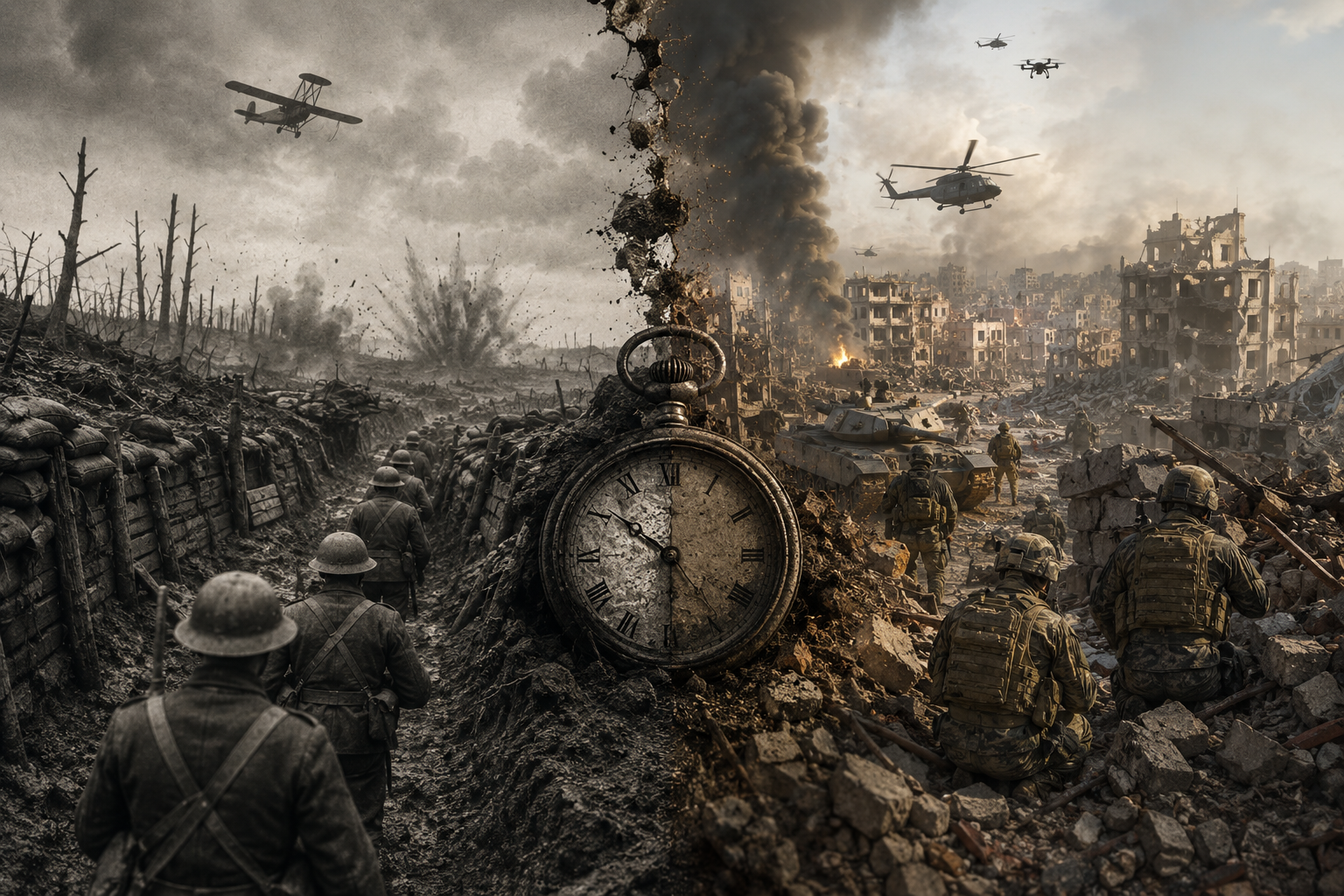
In the summer of 1914, people across Europe shared the same delusion: the great war about to begin would end all wars forever. Today, on June 20, 2026, those words sound no different from a cruel joke. The slogan “the war to end all wars,” which remains one of history’s most famous phrases, persists as proof of humanity’s unshakable ability to deceive itself.
Birth of a Slogan: The Peak of Optimism
The phrase “the war to end all wars” was first used by British writer and social critic H. G. Wells in an essay written in 1914. When Wells used the expression, he was not speaking in an ironic tone; like the liberal intellectuals of his era, he sincerely believed that this great struggle against German militarism would establish permanent world peace. Within a short time, the slogan found its way onto Entente propaganda posters, newspaper headlines, and street conversations, playing a leading role in sending millions of young men enthusiastically into uniform.
In the atmosphere of those days, there was a widespread belief that the war would be over in a few months. Soldiers who said, “We’ll be home before the leaves fall,” thought they would spend Christmas with their families. The reality, however, was hidden in the mud of the trenches, behind barbed wire, and in machine-gun fire.
A Propaganda Masterstroke: How the Slogan Went Global
Britain’s newly established War Propaganda Bureau instantly grasped the power of the slogan. Posters read “This war will end all wars,” and recruitment campaigns were built around this idea. By 1915, the phrase was making headlines even in North American newspapers, shaping public opinion in favor of U.S. entry into the war. Statistics show that in Britain alone, between August 1914 and January 1915, 2.5 million men volunteered for the army; a significant portion of them rushed to the front believing in the myth of the “final war.”
Battlefields of Disillusion: Broken Hopes at the Somme and Verdun
The emptiness of the slogan was most dramatically exposed in two giant battles on the Western Front. The Battle of Verdun, which began in February 1916, lasted 303 days and resulted in more than 700,000 casualties (dead, wounded, and missing). The Somme Offensive, launched in July of the same year, witnessed the bloodiest single day in human history: on July 1, 1916, the British Army alone suffered 57,470 casualties, 19,240 of them fatal. These figures were enough to shatter the idea of “the war to end all wars” within a matter of hours.
Letters and diaries of soldiers returning from the trenches clearly document how the slogan became a subject of mockery at the front. A note scribbled in a British corporal’s notebook sums up the mood of the era: “They said this war would end all wars. They were right—because it won’t leave any men to fight.”
Speaking in Numbers: Why Was It Such a Colossal Delusion?
The First World War ended with approximately 20 million dead and 21 million wounded. The 1918 flu pandemic that followed killed 50 million people. The “post-war world” bred a new thirst for revenge in Germany, crushed under the harsh terms of the Treaty of Versailles, and within just 20 years a far more destructive Second World War erupted. In other words, the slogan not only proved hollow but also laid the groundwork for future catastrophes.
Looking Back from 2026: Can Wars Ever Truly End?
As of June 20, 2026, the world does not appear to be on the brink of a global-scale war, but that does not mean peace prevails. Last year, in 2025, more than 20 active armed conflicts were recorded around the globe. As the war in Ukraine entered its fourth year, conflicts in Myanmar, Yemen, Sudan, and the Sahel region continued to displace millions. According to the Stockholm International Peace Research Institute’s (SIPRI) 2025 report, global military spending exceeded 2.5 trillion dollars for the first time, reaching a historic record.
Despite the passage of 110 years, the myth of the “final war” has been replaced by the reality of “perpetual war.” Ironically, H. G. Wells’s idealism survives only as a naïve memory in today’s multipolar world. The nature of war has changed; it has taken on entirely new dimensions with cyberattacks, drone technologies, and AI-powered autonomous systems, but the outcome remains the same: loss of human life and destruction.
The Bloodiest Lessons of Last Year: What Do the 2025 Conflicts Tell Us?
In 2025, military casualties on the front line in Ukraine alone surpassed 100,000, while civilian deaths were recorded at 12,000. The civil war in Yemen, now in its ninth year, has reached a death toll of 377,000, with 60 percent of those deaths caused by indirect factors (starvation, disease). These data prove that, contrary to the “war to end all wars” ideal, modern conflicts are never-ending, drawn-out spirals of devastation.
History’s Biggest Nonsense: Why Does the Slogan Still Haunt Us?
The human mind is programmed to cling to lofty ideals in order to justify actions that require great sacrifice. Slogans like “the war to end all wars” soothe the collective conscience and create a society willing to pay the heaviest prices. The “weapons of mass destruction” narrative before the 2003 invasion of Iraq or the “last bastion of democracy” discourse circulated around Ukraine after 2022 are products of the same psychological mechanism. Societies prefer to imagine war as an instrument of ultimate good rather than seeing its true cost.
Cognitive historians call this phenomenon the “sacrificial illusion.” Experiments show that the greater the existing sacrifices, the more fiercely people tend to believe that those sacrifices were not in vain. For a mother who lost her son at the Somme in 1916, saying “his death was for the final war” was perhaps the only way to make sense of the pain.
Pop Culture and War Narratives: A Recurring Illusion
From Hollywood to video games, many media products continue to reproduce the myth of the “final war.” From the Last Alliance of Elves and Men in “The Lord of the Rings” to the universe-saving ultimate clash in “Avengers: Endgame,” narratives carry the same code: a great war will be fought, and eternal peace will follow. “Final Front,” a Pentagon-backed game released in 2026, promises players the chance to win “humanity’s last war” with a similar theme. Art’s insistent repetition of this motif proves how deeply the slogan is embedded in our cultural DNA.
The fact that a slogan written 110 years ago still echoes today exposes humanity’s reluctance to learn from history. On June 20, 2026, just like yesterday, we need to speak not of a war to end all wars, but of a new global mindset rooted in diplomacy, empathy, and fair distribution. So, do you think “the war to end all wars” is a purely utopian dream, or will humanity one day break free from this illusion and build genuine peace? Share your views with us and become part of this critical debate.
