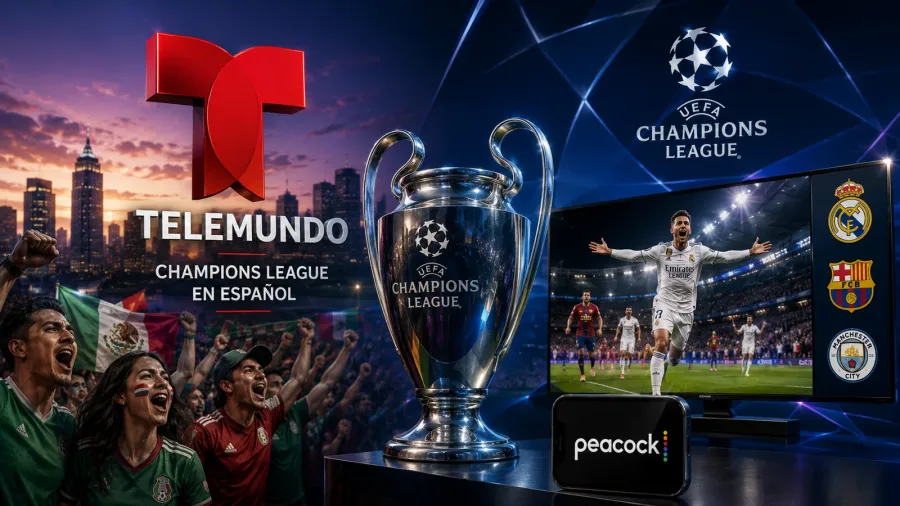
NBCUniversal's Telemundo has pulled off a major coup in the sports broadcasting landscape, securing the exclusive U.S. Spanish-language rights to the UEFA Champions League starting from the 2027-28 season. The deal, announced Monday, comes on the heels of a record-shattering 2026 FIFA World Cup that fundamentally altered the commercial trajectory of soccer in North America and positioned Telemundo as an aggressive contender in the battle for premium sports content.
A strategic pivot in the post-World Cup landscape
The timing of Telemundo's acquisition is far from coincidental. The 2026 World Cup, co-hosted by the United States, Mexico, and Canada, generated unprecedented viewership numbers across all demographics, with Telemundo alone drawing 22 million viewers for the final match. The tournament shattered attendance records with over 5.5 million fans filling stadiums, while U.S. stadiums alone generated more than $3 billion in ticket revenue. This surge in soccer's popularity created a fertile ground for broadcasters looking to capitalize on the sport's momentum, and Telemundo moved swiftly to lock down one of club soccer's crown jewels.
The Champions League represents a year-round engagement opportunity that the quadrennial World Cup cannot offer. With matches scheduled on Tuesdays and Wednesdays throughout the European season, Telemundo gains a consistent prime-time soccer property that keeps viewers tethered to the network between international tournaments. Industry analysts estimate the deal could be worth upwards of $250 million annually, reflecting the premium that live sports command in an era of cord-cutting and fragmented audiences. For NBCUniversal, the acquisition strengthens its already formidable sports portfolio, which includes Premier League rights through NBC Sports and Olympics coverage, creating a near-unbroken calendar of elite soccer content.
The demographic calculus behind the deal
The business logic underpinning Telemundo's investment rests on solid demographic foundations. As of 2026, the U.S. Hispanic population exceeds 65 million, representing approximately 19% of the total population and wielding an estimated $2.1 trillion in purchasing power. Soccer serves as a powerful cultural touchstone for this community, particularly for viewers of Mexican, Central American, and South American descent who maintain deep emotional connections to the European clubs where many of their national team stars compete. Real Madrid, Barcelona, and an increasing number of Premier League clubs feature prominently in the sporting consciousness of this demographic, making Champions League broadcasts a natural fit for Telemundo's audience.
How Telemundo is disrupting the U.S. broadcasting hierarchy
Telemundo's acquisition of Champions League rights represents a significant disruption to the established order of U.S. soccer broadcasting. For years, English-language networks like CBS/Paramount (the current rights holder), ESPN, and Fox have dominated the conversation around premium soccer properties. The shift of such a marquee tournament to a Spanish-language broadcaster signals a recognition that the center of gravity in American soccer fandom has shifted. It is no longer a niche sport for suburban Anglophone households but a mainstream passion driven substantially by Hispanic audiences who prefer consuming content in Spanish.
The competitive implications are far-reaching. CBS, which has held the English-language rights since 2021 and built its soccer identity around the Champions League, now faces the prospect of sharing the spotlight with a network that may actually draw larger audiences for key matchups involving Spanish giants or Latin American stars. Telemundo's experienced commentary team, featuring well-known voices from across Latin America, provides an authenticity that English-language broadcasts often struggle to replicate. This cultural resonance translates directly into viewer loyalty and, consequently, advertising revenue. During the 2026 World Cup, Telemundo's ad sales reached $750 million, and the Champions League is expected to add $400-500 million in annual advertising income.
Streaming strategy and the hybrid distribution model
Telemundo plans to deploy a hybrid distribution strategy for its Champions League coverage, airing matches on its linear television network while simultaneously streaming them on Peacock, NBCUniversal's digital platform. This dual approach addresses the ongoing cord-cutting trend that has seen traditional cable subscriptions decline while providing a direct-to-consumer option for younger, digitally native viewers. The strategy mirrors successful models employed by other broadcasters but benefits from Telemundo's unique ability to serve Spanish-language content to an audience that often feels underserved by mainstream English-language streaming services.
What this means for UEFA and the global soccer economy
For UEFA, European soccer's governing body, the Telemundo deal represents a validation of its long-term strategy to grow the Champions League's footprint in the Americas. The U.S. market has become increasingly crucial to the financial ecosystem of European football, with American investors now holding stakes in dozens of clubs across England, Italy, Spain, and France. The combination of CBS's English-language rights and Telemundo's Spanish-language deal is expected to push total U.S. broadcasting revenue for the Champions League past the $2 billion mark, cementing America's status as the most lucrative overseas market for European club competitions.
The agreement also reflects a broader recognition within global sports organizations that linguistic diversity is not a barrier but a commercial asset. Spanish-language broadcasts often outperform their English-language counterparts in key U.S. markets like Los Angeles, Miami, Houston, and New York, where Hispanic populations are concentrated. UEFA has taken note, increasingly tailoring its digital content and marketing campaigns to Spanish-speaking audiences in the Americas. The Telemundo partnership will accelerate this trend, with the network expected to produce extensive shoulder programming, including pre-match shows, analysis segments, and digital content designed specifically for its core audience.
European clubs intensify their American outreach
The Telemundo deal arrives as Europe's elite clubs are deepening their engagement with the American market. Real Madrid, Barcelona, Manchester City, and other super-clubs have expanded their social media presence in Spanish, recognizing that language-specific content drives higher engagement rates among U.S.-based fans. Pre-season tours to American cities have become standard practice, and several clubs have established permanent commercial offices in New York and Miami. Telemundo's Champions League coverage will provide these clubs with an invaluable platform to reach the exact demographic they are courting, creating a symbiotic relationship between broadcaster, competition organizer, and participating teams.
What comes next for U.S. soccer broadcasting
Telemundo's bold move is likely to trigger a chain reaction across the U.S. sports media landscape. With the 2028 Summer Olympics in Los Angeles on the horizon and the 2030 World Cup set to return to the Americas, the competition for premium soccer rights will only intensify. Univision, Telemundo's arch-rival in the Spanish-language market, may be forced to respond with its own high-profile acquisition, potentially targeting rights to South American competitions like Copa Libertadores or expanding its Liga MX coverage. Meanwhile, English-language broadcasters will face pressure to differentiate their offerings in a market where Spanish-language coverage increasingly sets the standard for authenticity and audience engagement.
For American soccer fans, the outcome is unequivocally positive. The proliferation of broadcast options, combined with the competitive pressure to deliver high-quality production, means viewers will have unprecedented access to the world's best club soccer. Telemundo's entry into the Champions League ecosystem ensures that Spanish-speaking fans—long the backbone of American soccer culture—will finally see their linguistic and cultural preferences reflected in how the sport's premier club competition is presented. The 2027-28 season cannot arrive soon enough for a network that has bet big on soccer's American future, and for the millions of fans ready to answer the call.
