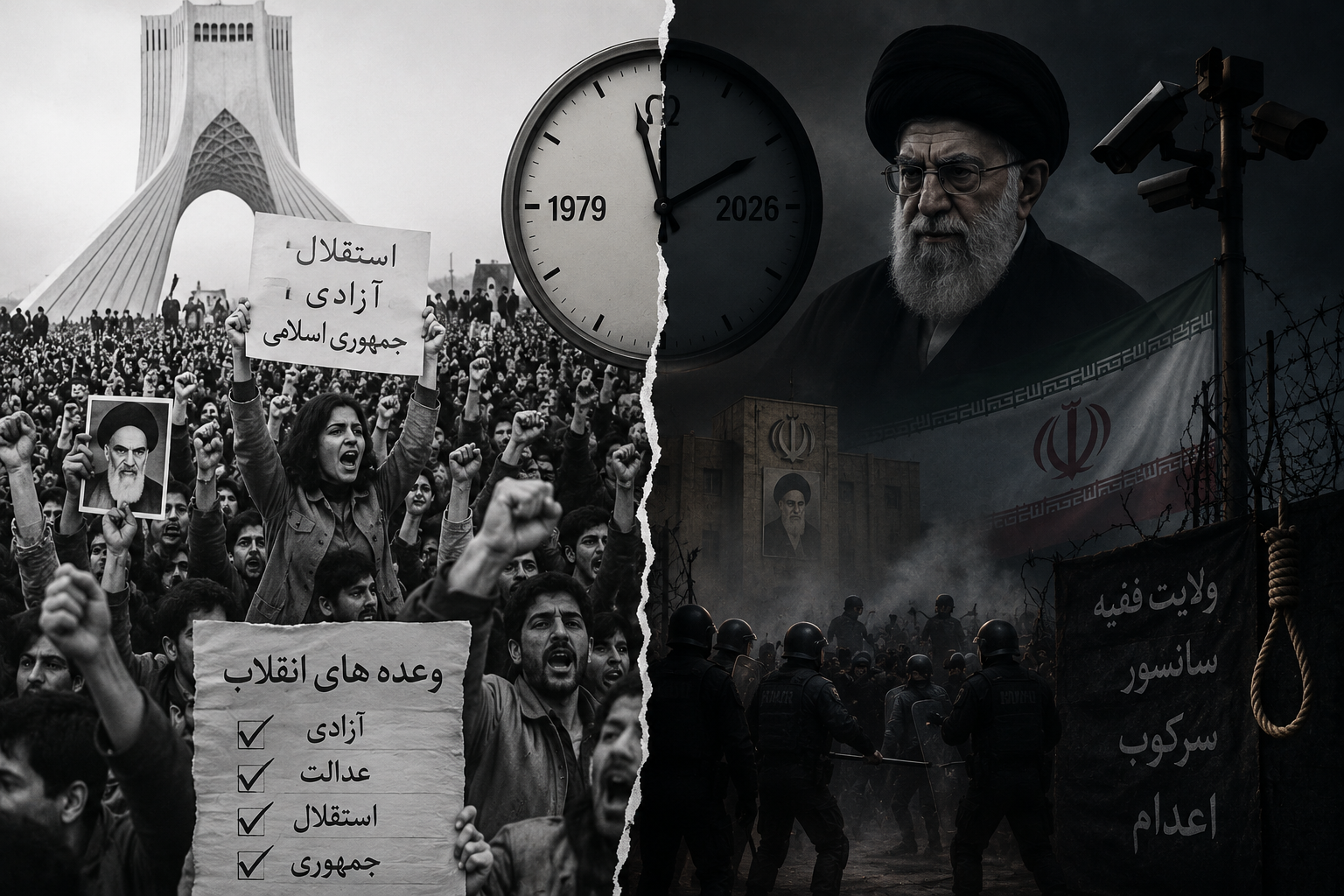
The chant 'Independence, Freedom, Islamic Republic' echoed through the streets of Tehran, rewriting the destiny of a nation in 1979. Yet, for the millions of Iranians who filled the squares that year, that dream had curdled into deep-seated regime fatigue and suppressed rage by 2026. The broad coalition that gave the revolution its soul—leftists, nationalists, intellectuals, and bazaar merchants—moved with a shared hope for democracy; however, events quickly spiraled out of control, witnessing the birth of a theocracy instead.
The Democratic Promises of the Revolution's Early Days
From his exile in Paris, revolutionary leader Ayatollah Khomeini's initial statements signaled an inclusive democratic system. His rhetoric—that 'soldiers would return to their barracks and mullahs to their mosques'—united secular and religious factions on a common platform. When 98.2% of voters said 'yes' to the Islamic Republic in the referendum of March 30-31, 1979, the masses turning out at the ballot box actually expected a parliamentary system that would end the autocracy of the Shah's regime.
The Sharp Break with Velayat-e Faqih
Behind the scenes, however, Khomeini and his hardline followers were constructing a vastly different constitutional architecture. The doctrine of 'Velayat-e Faqih' (Guardianship of the Jurist) created an office above all elected bodies, binding all state power to the clerical Supreme Leader. Following constitutional interpretations updated just last year, by 2026, neither the parliament nor the president in Iran can implement the smallest policy without the approval of Supreme Leader Ali Khamenei. The wave of executions that began with the first Revolutionary Courts in the summer of 1979 was, in fact, the first blade that nipped the dream of 'democracy' in the bud.
The Vicious Cycle Between Reform and Repression
The Iranian people never gave up on going to the polls. Mohammad Khatami's landslide victory in 1997 and Hassan Rouhani's unexpected rise in 2013 repeatedly revived hopes for reform. Yet, the Guardian Council's power to veto candidates had reduced every reformist government to a helpless figurehead by 2026. When the Nuclear Deal (JCPOA) negotiated during the Rouhani era—and the brief economic relief it brought—collapsed following the US withdrawal, the public's faith in the system was shattered once again.
The Protest Waves Spanning from 2022 to 2026
The 'Woman, Life, Freedom' movement, triggered by the death of Mahsa Amini in police custody in September 2022, was the embodied rebellion of the 'Stolen Revolution.' Those protests were suppressed and thousands were arrested, but their memory was not erased. The short-lived flare-ups at university campuses and bazaars in early 2026 expose the explosive atmosphere created by economic collapse and political deadlock. With the exchange rate at historic lows and more than 60% of the population living below the poverty line, the revolution's promise of 'economic justice' remains completely unfulfilled.
Geopolitical Isolation and Introversion
For those who believe the revolution was 'betrayed,' the Iran-Iraq War, which broke out in 1980, was a watershed moment. The eight-year conflict allowed the regime to silence all domestic dissenting voices by equating them with 'treason in a state of war.' That same security-driven reflex is still alive in 2026. While Tehran pours billions of dollars into its network of regional proxies, framing this policy as a national security imperative, the average Iranian citizen is less concerned about Lebanon or Yemen than about their child’s school fees. The regional tensions between 2023 and 2025 only deepened this disconnect.
The Legitimacy Crisis and Future Scenarios
According to experts, the Iranian regime has completely lost its founding revolutionary legitimacy and is trying to substitute it with an 'external enemy' narrative. However, the widespread access to digital media in 2026 makes the walls of propaganda more porous than ever. Voter turnout in the elections hit historic lows throughout 2024 and 2025; this signifies not just a boycott but the collapse of the 'pseudo-democracy' image that the Islamic Republic leveraged through the ballot box.
Conclusion: The Burden of Stolen Dreams
By 2026, Iran's 'Stolen Revolution' has settled as a heavy burden on the nation's shoulders. The heirs of those who shouted 'freedom' in the streets are now searching for their most basic rights inside a system that started with that very same slogan. The bright democracy the revolution promised has now been replaced by martial-law-like internet controls, compulsory hijab enforcement, and an existential economic crisis. So, will history repeat itself? Or will Iranian society find a new way to finally settle the account that has been postponed for half a century?
