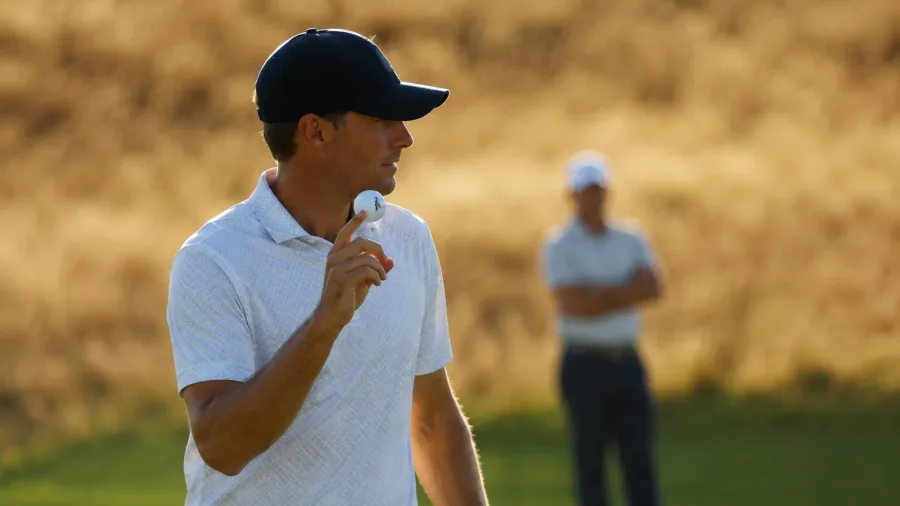
The bitter rivalry between Rory McIlroy and Bryson DeChambeau reached a new peak at the 154th Open Championship, as accusations of 'performative' behavior and gamesmanship overshadowed the action at Scotland's iconic Royal Troon links. McIlroy's claim that DeChambeau was 'holding the tournament hostage' after a controversial two-shot penalty has not only reignited their personal feud but also exposed the deeper fractures that continue to divide professional golf in 2026.
The incident that sparked a firestorm
The drama unfolded during the third round when DeChambeau, the American star and one of LIV Golf's most prominent figures, found his ball in a difficult lie near the 12th green. What followed was an eight-minute exchange with rules officials as DeChambeau argued for a free drop, claiming his ball was embedded. The initial ruling went against him, and a second official was summoned to confirm the decision, resulting in a two-stroke penalty for the American.
McIlroy, speaking to reporters after his round, did not hold back. The Northern Irishman, who has four major championships to his name, accused DeChambeau of deliberate gamesmanship. 'It's completely performative. He's holding the entire championship hostage and wasting everyone's time,' McIlroy stated bluntly. The choice of the word 'performative' struck a nerve, implying that DeChambeau's drawn-out protest was less about seeking a fair ruling and more about creating a spectacle.
The rules debate and pace of play concerns
At the heart of the dispute lies a fundamental question about pace of play in professional golf. The R&A, which governs The Open, has emphasized the need to maintain a brisk tempo, yet enforcement remains inconsistent. DeChambeau's camp argued that the complexity of the lie warranted a thorough review, while critics pointed out that the delay affected multiple groups behind him, disrupting the rhythm of the entire field.
Television analyst Brandel Chamblee offered a nuanced take during the broadcast. 'There is some validity to what Rory is saying, but his own career is not spotless in this regard. This feels a bit like throwing stones from a glass house,' he remarked. The comment underscored a growing sentiment among golf insiders that while DeChambeau's actions may have been excessive, McIlroy's moral high ground is not as solid as he might believe.
McIlroy's complicated history with gamesmanship
McIlroy's criticism, however justified in the moment, has invited scrutiny of his own past conduct. Throughout his illustrious career, which as of 2026 includes 24 PGA Tour victories, the Northern Irishman has faced accusations of slow play and strategic delays during critical moments. During the 2023 Ryder Cup, McIlroy engaged in a lengthy pre-shot routine that visibly frustrated his American opponents, later defending it as 'a game of strategy where every shot must be calculated.'
More recently, at the 2025 Masters, McIlroy's extended deliberation over a difficult chip shot drew ironic commentary on social media, with many users recycling his own words about 'performative' behavior. This pattern raises uncomfortable questions: where is the line between legitimate strategic deliberation and the very showmanship McIlroy now condemns?
The LIV Golf subtext
The confrontation cannot be fully understood without acknowledging the schism that has fractured professional golf. McIlroy has been one of the PGA Tour's most vocal loyalists, while DeChambeau's 2022 defection to the Saudi-backed LIV Golf series made him a symbol of the sport's division. Although McIlroy softened his stance in late 2025, calling for 'a time for peace,' the Royal Troon incident demonstrates that genuine reconciliation remains elusive.
DeChambeau's five-word response to McIlroy's attack—'I just questioned the rules'—was masterfully understated. It positioned him as a player simply seeking clarity within his rights, while casting McIlroy as overly aggressive. This minimalist rebuttal has resonated with many fans, particularly younger audiences who have embraced DeChambeau's YouTube presence and more accessible public persona.
Broader implications for the 2026 season
This clash arrives at a pivotal moment for the sport. The protracted negotiations between the PGA Tour and LIV Golf's backers remain unresolved, and incidents like this only deepen the existing animosities. Tournament organizers face increasing pressure to enforce pace-of-play rules uniformly, regardless of a player's tour affiliation or star power. Failure to do so risks alienating fans who are already weary of the political undercurrents overshadowing the competition itself.
As the 2026 Open Championship heads into its final round, McIlroy trails the leader by three strokes, while DeChambeau sits five back. Both remain within striking distance of the Claret Jug, and their war of words has added an extra layer of drama to what was already shaping up to be a memorable finale. Regardless of who lifts the trophy, the McIlroy-DeChambeau dynamic will continue to be one of golf's most compelling narratives.
The global view: From fairways to boardrooms
For the international golf community, this episode serves as a case study in how personal rivalries can both elevate and undermine the sport. Major sponsors and broadcasters are closely monitoring the situation, aware that controversy drives ratings but also threatens the gentlemanly image that golf has cultivated for centuries. The delicate balance between entertainment and tradition has never been more precarious.
As Sir Nick Faldo observed during the broadcast, 'Both players feed off this rivalry, that's clear. But the rules must apply equally to everyone. If slow play is penalized, it cannot be selectively enforced against LIV players.' That call for consistency is likely to grow louder in the coming months, as the golf world continues to navigate its fractured present toward an uncertain future.
