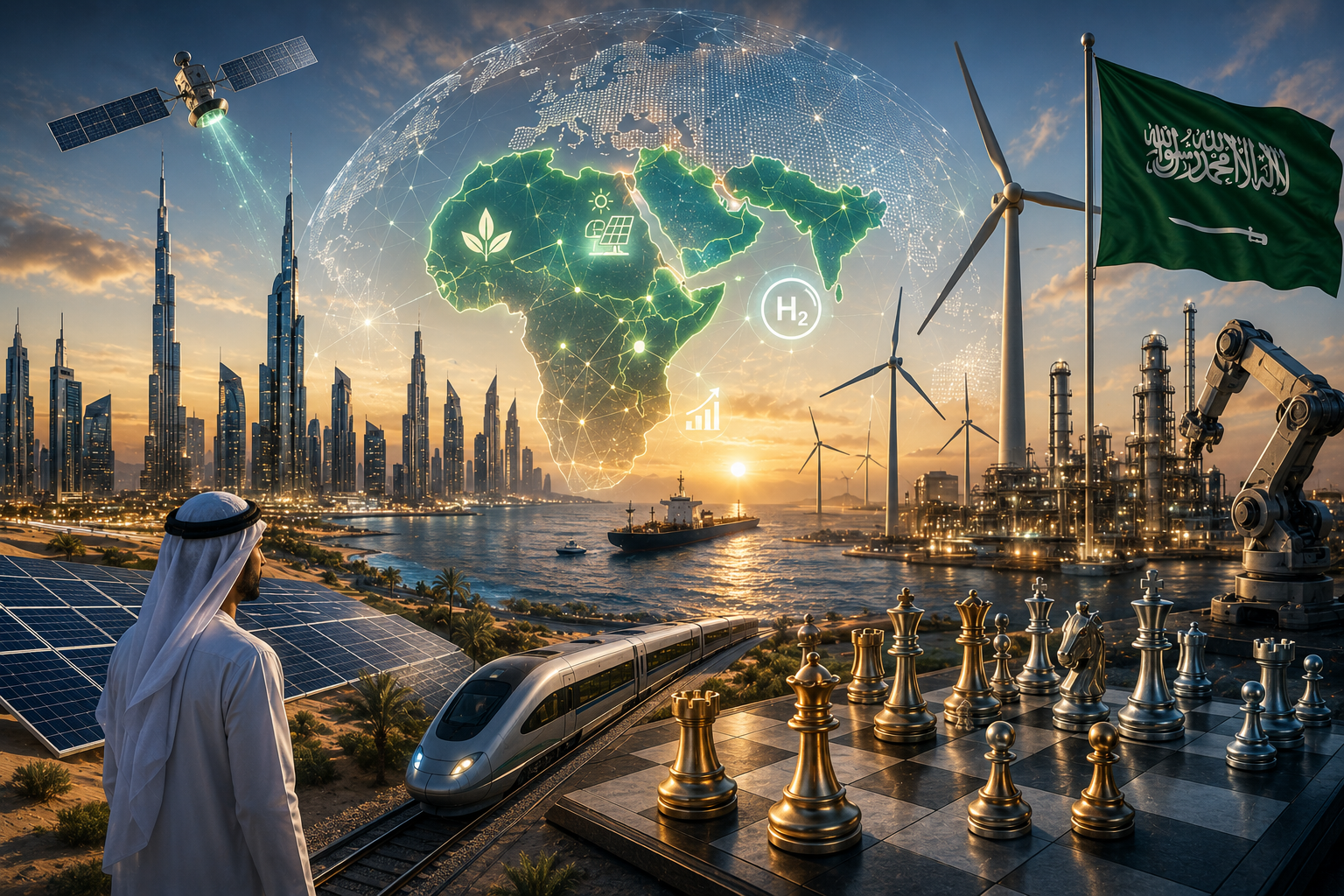
The year 2026 is cementing itself as a watershed for the Middle East and North Africa — not because of conflict or oil price shocks, but because a silent blueprint for prosperity is quietly redrawing the region. Digital leaps, green hydrogen corridors and unprecedented diplomatic overtures are pushing this ancient land to the heart of the global economy.
Beyond Petrodollars: The Great Economic Rebalancing
Over the past five years, regional powers have deployed the most ambitious transformation programs in their history to curb hydrocarbon dependency. By mid-2026, Saudi Arabia’s non-oil GDP share hit 52% for the first time, driven by tourism, entertainment and logistics sectors that drew over $100 billion in foreign direct investment last year alone. Egypt, meanwhile, completed its new administrative capital, creating Africa’s largest smart-city ecosystem and luring tech giants with tax-free zones.
Saudi Arabia’s $3.2 Trillion Vision 2030 Enters Its Final Act
Since its 2016 launch, Vision 2030 has become the region’s economic compass. The first phase of NEOM is now operational, housing 450,000 residents in a city fully powered by renewables. Along the Red Sea coast, luxury tourism projects welcomed 30 million visitors in 2026, making the kingdom the world’s fastest-growing tourism destination. These moves have engineered a buffer that keeps the economy resilient even if crude dips below $70 a barrel.
Digital Darwinism: How Tech Is Redefining the Workforce
With the youngest population on the planet, MENA has become one of the fastest-digitizing markets. By mid-2026, the region’s digital economy crossed the $220 billion mark, fueled by mobile payment platforms driving cashless societies from Morocco to Egypt. AI incubators in Dubai and Riyadh are now training more than 15,000 entrepreneurs annually, while government upskilling programs aim to create 10 million digital jobs by decade’s end.
From Casablanca to Cairo: The Rise of Africa’s Silicon Oases
Morocco and Jordan have emerged as unexpected tech-outsourcing powerhouses, leveraging proximity to Europe and multilingual talent pools. Morocco’s tech park near Casablanca employs 50,000 workers, while Jordan’s coding bootcamps graduated 10,000 female software engineers in 2026 alone. This quiet revolution is reversing brain drain and sparking a return wave of skilled diaspora professionals.
The Climate Imperative: Green Hydrogen and Water Wars
A scorching 53°C reading in the Gulf this summer reminded everyone that climate crisis is no longer a luxury debate. On the same day, the UAE and Egypt inked a $10 billion deal for the first green hydrogen pipeline corridor to Europe. Riding abundant solar and wind, MENA aims to supply 18% of the world’s green hydrogen by 2030. Yet, water scarcity remains the Achilles’ heel; desalination investments surged to $12 billion in 2026 to sustain these ambitions.
The $10 Billion Gamble: A Hydrogen Highway to Europe
Spearheaded by Masdar, the infrastructure linking the Gulf to Italy and Germany will carry 2 million tons of green ammonia per year once fully operational in 2029. It is the cornerstone of Europe’s push to ditch Russian gas and a symbol of institutional trust in the region’s energy transition. Early offtake agreements already cover 70% of future output, signaling strong market confidence.
The Chessboard Reconfigured: Diplomacy in an Age of Détente
On the geopolitical front, 2026’s headline development was the final-stage normalization talks between Israel and Saudi Arabia, while ongoing Iran-Saudi détente extended the Yemen ceasefire into its seventh year. The region, now at the center of the US-China global rivalry, has turned into a laboratory for multi-polar diplomacy where old foes negotiate trade and security pacts.
Gaza’s $50 Billion Rebuild: A Stabilization Blueprint or Mirage?
The large-scale reconstruction that began in 2025 accelerated in 2026 with a flood of international funding. Jointly financed by Gulf states and the European Union, the project aims to deliver 200,000 housing units and modern infrastructure. But experts warn that economic recovery without a political framework remains fragile. The region is living through its most ambitious peace-building effort yet, and one question looms: Can leaders keep the momentum when oil prices inevitably dip again?
