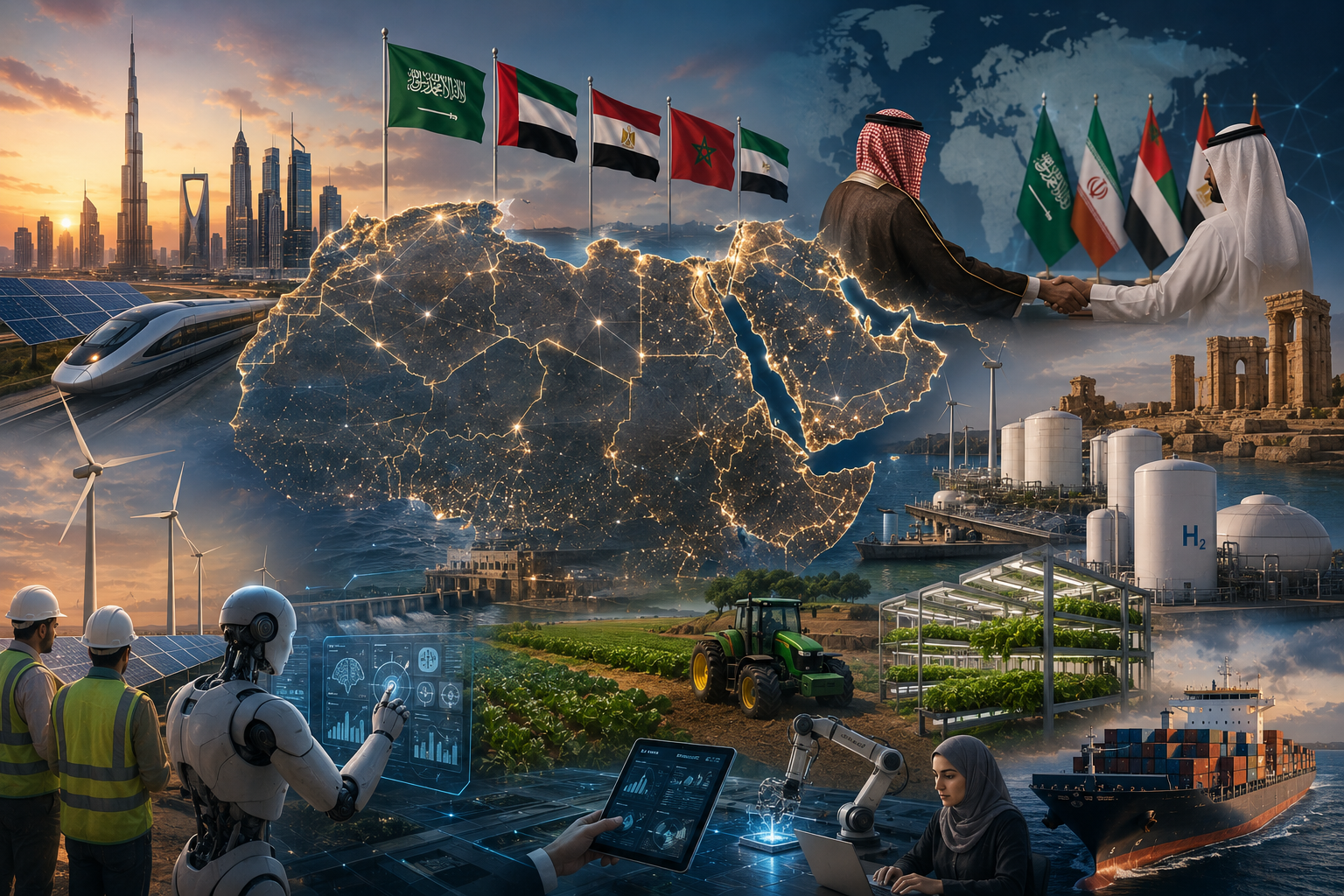
The Middle East and North Africa is not waiting for the future anymore — it's building it. As we reach mid-2026, the region is shaking off outdated narratives and carving a new identity through economic reinvention, diplomatic recalibration, and technological ambition that would have seemed improbable just five years ago.
Drawing on the World Economic Forum's network of leaders and analysts, this deep dive unpacks the forces reshaping MENA in real time. From green hydrogen megaprojects to AI-powered governance, from fragile peace deals to water wars averted — here's what's actually happening on the ground, backed by the numbers that matter.
Economic Transformation: The Post-Oil Era Takes Shape
Here's the number defining 2026: non-oil revenues now account for 58% of total GDP across the Gulf Cooperation Council (GCC), up from 52% last year. Saudi Arabia's Vision 2030 has hit its stride, with the kingdom's tourism sector alone generating $38 billion in the first half of 2026. The UAE, meanwhile, has positioned itself as the world's third-largest fintech hub by transaction volume, trailing only London and Singapore.
The picture beyond the Gulf is more uneven. Egypt's external debt has climbed to $178 billion, forcing Cairo into painful subsidy reforms that sparked protests in Alexandria last March. Tunisia's democratic transition remains stalled by economic paralysis — inflation hit 14.7% in May 2026. Yet Morocco tells a different story: automotive and aerospace manufacturing exports surged 14% year-on-year, making Casablanca a quiet industrial powerhouse. The WEF's regional risk assessment warns that this growth divergence risks creating a two-speed MENA that could fuel migration pressures and social unrest.
Green Hydrogen: The New Oil Rush?
By mid-2026, planned green hydrogen projects across MENA have surpassed $65 billion in combined investment value. Oman's Duqm facility — set to reach full capacity by year-end — will begin exporting to European markets under long-term contracts signed with German and Dutch energy firms. Morocco and Algeria are racing to secure their own slices of the hydrogen pie. This isn't just an energy transition story; it's a redefinition of the region's place in global supply chains. The question is whether hydrogen can employ the millions of young workers currently dependent on hydrocarbon industries.
Geopolitical Chessboard: Alliances, Rivalries, and Fragile Peace
The Iran-Saudi Arabia rapprochement has accelerated in 2026 beyond what most analysts predicted. Bilateral trade is up 40% compared to last year, and a joint investment fund — seeded with $3 billion from each side — has greenlit its first infrastructure projects. This thaw is breathing life into Yemen's ceasefire, with UN-led talks in Muscat inching toward a permanent settlement. Yet fragility defines the broader security landscape: northern Syria remains a patchwork of rival militias, and Lebanon's 19-month political vacuum continues with no breakthrough in sight.
On the Israel-Palestine track, 2026 has seen intensified international mediation — the WEF's annual meeting in Davos hosted back-channel discussions — but concrete progress remains elusive. Regional experts within the WEF network increasingly argue that economic integration projects, particularly shared water and energy infrastructure, could build the trust necessary for political breakthroughs.
North Africa's Security Paradox
Instability across the Sahel belt is pushing Algeria and Mauritania to boost defense budgets, while Tunisia wrestles with the twin challenges of economic recovery and democratic institution-building. Average defense spending across North Africa has reached 4.2% of GDP — the highest level in 15 years. The paradox is stark: countries need stability to attract investment, but the investment drought makes stability harder to achieve.
Technology Leap: The Digital Infrastructure Race
The Middle East has climbed to fourth place globally in AI investment per capita in 2026, trailing only the US, China, and Israel. Saudi Arabia's NEOM is running live tests of autonomous city management systems; the UAE has migrated 90% of government services onto blockchain-based platforms. These aren't pilot projects anymore — they're operational infrastructure reshaping how citizens interact with the state.
The startup ecosystem tells an equally compelling story: MENA-based ventures raised $4.3 billion in the first half of 2026 alone. Fintech dominates, but logistics tech and health tech are the fastest-growing verticals. Egyptian mobility platforms, inspired by Swvl's trajectory, are expanding into Pakistan and Kenya — tangible examples of South-South cooperation that challenge the old North-South aid paradigm. The WEF's 2026 Technology Pioneers cohort includes three MENA startups for the first time, signaling the region's arrival on the global innovation map.
Closing the Digital Divide: Progress and Persistent Gaps
Broadband internet penetration has reached 74% across the region, but rural Yemen and parts of Sudan still hover below 20%. This digital divide isn't just about connectivity — it's about access to education, telehealth, and economic opportunity. The WEF's EDISON Alliance initiative aims to connect an additional 80 million people in MENA by the end of 2026, but on-the-ground realities in conflict zones make the target ambitious.
Climate and Water: The Existential Reckoning
Summer 2026 arrived with brutal temperatures — Baghdad hit 52°C in June — and a stark reminder that MENA is ground zero for climate change. Fourteen countries in the region now face severe water stress. Jordan's annual renewable water per capita has fallen below 90 cubic meters, far beneath the 500-cubic-meter threshold that defines absolute scarcity. The numbers are not abstract; they translate into rising food prices, displacement, and political tension.
Yet crisis is breeding innovation. The UAE's cloud seeding operations boosted rainfall by 30% in 2026. The Israel-Jordan water-for-energy deal — solar power in exchange for desalinated water — has secured $400 million in World Bank financing and is being studied as a model for other transboundary water partnerships. These projects demonstrate that climate adaptation can be a pathway to regional cooperation rather than just a source of conflict.
Food Security on the Edge
The 2025 grain crisis triggered by the war in Ukraine was a painful wake-up call about MENA's import dependency. In response, Egypt doubled its vertical farming investments in 2026 and diversified wheat sourcing toward India. Morocco, leveraging its position as Africa's largest fertilizer producer, is playing an increasingly strategic role in continental food security. The lesson is sinking in: resilience means producing, not just purchasing.
MENA stands at a crossroads in mid-2026, and the choices made this year will echo for decades. Adaptation to a post-oil world, geopolitical normalization, and technological transformation are not separate stories — they are interwoven threads pulling the region toward either fragmentation or renewal. The WEF's data shows the opportunity window is open but narrowing fast. So we ask you: which transformation matters most for MENA's future — energy, diplomacy, or technology? Join the conversation.
