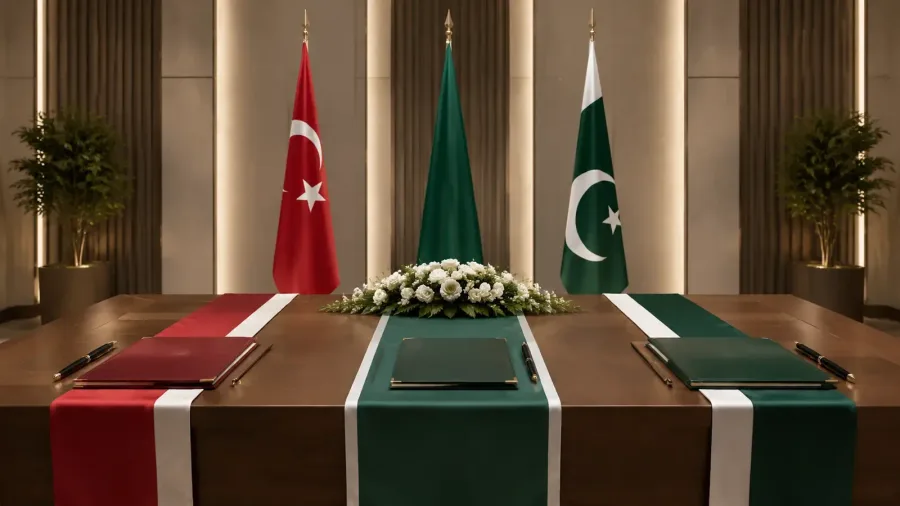
Turkish Foreign Minister Hakan Fidan said the Mecca Joint Defence Agreement signed by Türkiye, Saudi Arabia and Pakistan is not directed against Iran or any other country. His comments on August 8 offered one of the first detailed Turkish explanations of the trilateral pact signed in Mecca a day earlier. Reuters and the Associated Press reported that Fidan presented the agreement as a general security and deterrence mechanism intended to support the three partners rather than as an alliance built around a named adversary.
What does the agreement require?
A joint statement published by the official Saudi Press Agency on August 7 says an armed attack against one of the three countries will be regarded as an attack against all of them. The stated aims include strengthening collective deterrence, expanding defence cooperation and contributing to regional peace and stability. President Recep Tayyip Erdogan, Saudi Crown Prince and Prime Minister Mohammed bin Salman, and Pakistani Prime Minister Shehbaz Sharif signed the agreement in Mecca.
Fidan compared the technical structure of the mutual-defence clause with NATO's Article 5. He also said the new arrangement was not designed to replace NATO or any other existing alliance. According to Reuters, the minister stressed that no country would be treated as a common threat unless it attacked one of the members. That clarification directly addresses speculation that the three-party mechanism was created against a specific state.
Support would be decided through consultations
The Associated Press reported that if one partner formally requested assistance, the other two would decide the level and form of support through consultations. Fidan said possible assistance could range from intelligence sharing and logistical support to broader defence contributions, depending on the scale of the threat. The agreement therefore does not establish one automatic response for every incident. It creates a framework in which the partners would assess the circumstances and determine the appropriate support together.
The pact is also expected to receive a permanent institutional structure. Fidan said a committee involving foreign and defence ministers as well as senior military officials would meet regularly. A general secretariat based in Saudi Arabia is also planned. Reuters reported that operational details are to be discussed at the committee's first meeting. Those elements indicate that the countries intend to manage the agreement through recurring consultations and an administrative body rather than leaving it as a one-time political declaration.
Expansion is possible but not confirmed
Fidan said President Erdogan wanted the arrangement eventually to include more regional countries. He mentioned Egypt as a possible future participant, while adding that technical issues would need to be resolved first. There is currently no signed decision or announced timetable for Egypt to join. Any expansion should therefore be treated as a possibility under discussion, not as a completed step.
The agreement's practical significance will become clearer when the partners define the committee's procedures, the process for requesting assistance and the areas in which they plan to develop shared capabilities. The official joint statement establishes the central collective-defence principle, while Fidan's explanation says implementation will depend on consultation and the circumstances of each case. Future joint decisions and the results of the first committee meeting will provide the next concrete indicators of how the mechanism will operate.
