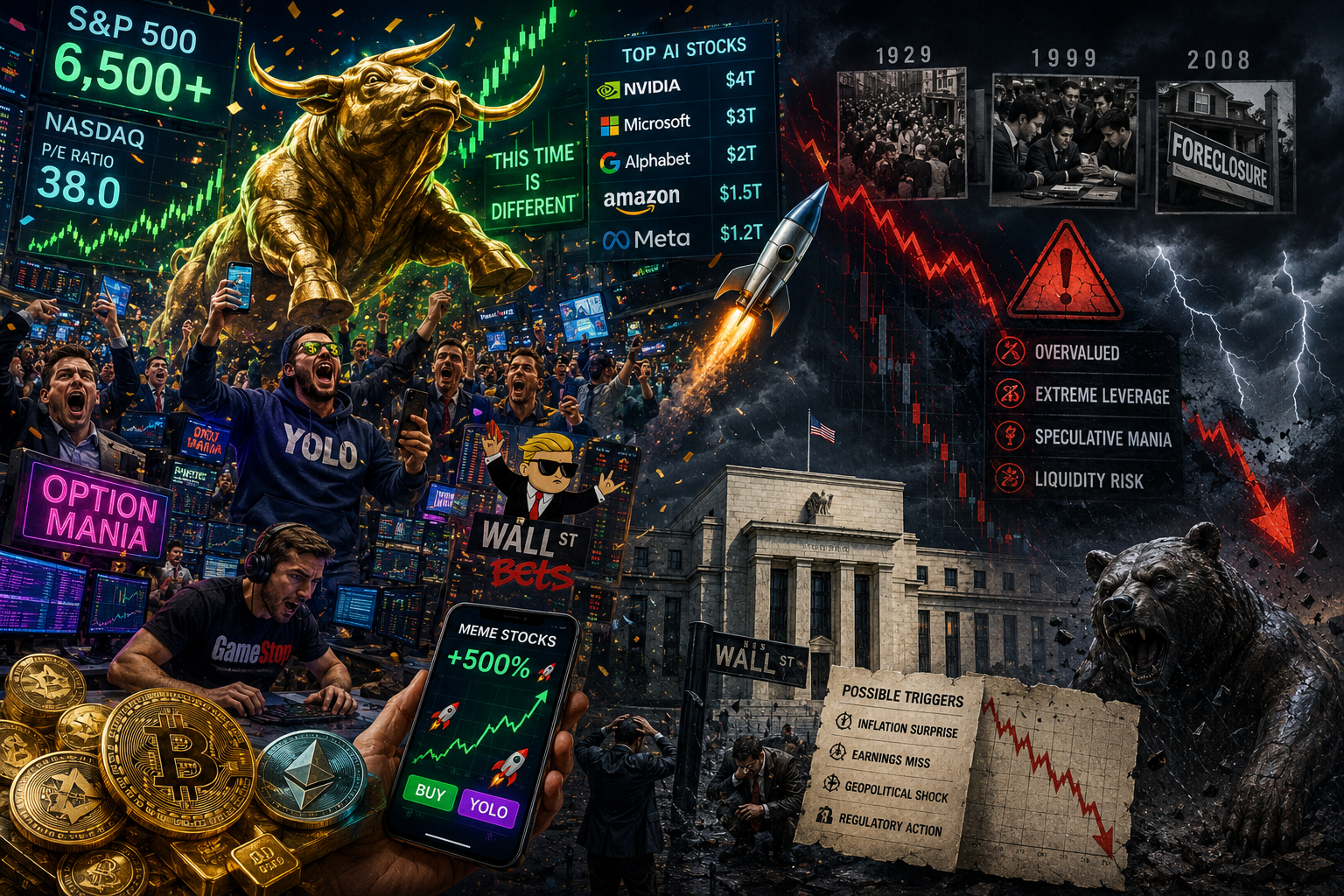
In the summer of 2026, the American equity party is thundering louder than ever. The S&P 500 has just breached 6,500, the Nasdaq trades at a price-to-earnings ratio of 38, and daily options volume on U.S. exchanges has tripled since 2024. This is not a normal bull market — it is a euphoric, leveraged, all-in mania that veteran traders compare only to the final chapters of historic bubbles.
As investors embrace the 'this time is different' mantra, a mosaic of warning signs echoes the pre-crash landscapes of 1929 and 1999. Stock valuations have detached from fundamentals, zero-day options have turned into a casino, and crypto assets are now a staple in mainstream portfolios. Here are the four defining hallmarks of America’s manic bull market in 2026, and what an eventual reckoning might look like.
The Hallmarks of a Manic Market
Today’s setup paints a speculative bubble rarely seen in modern finance. The Shiller CAPE ratio stands at 41, surpassing the 1929 peak of 33 and closing in on the 44 level reached at the end of 1999. Equities are priced for perfection, with investors pre-paying growth that may never materialize. The S&P 500 skyrocketed 34% in 2025 and added another 18% in the first half of 2026, proving momentum is still furious. But at this point, questioning the sustainability of those gains is no longer optional.
Valuation Stretches Beyond Historical Norms
By traditional yardsticks, U.S. stocks are trading at 24 times forward earnings, while tech behemoths command multiples above 40. Artificial intelligence-themed companies — much like internet startups during the dot-com era — have reached trillion-dollar valuations before delivering concrete profits. Nvidia’s market cap nearing $4 trillion is the most glaring symbol of this hysteria. These levels leave virtually zero margin for error, where even a mild earnings disappointment could trigger cascading sell-offs.
The Options Casino Goes Retail
Average daily call option volume on U.S. exchanges hit 62 million contracts in May 2026, a 240% jump from 2023 levels according to OCC data. The explosion in zero-day-to-expiry options has created a gambling environment where traders bet on intraday swings with breathtaking leverage. The 'YOLO' culture popularized by forums like WallStreetBets has spawned a new generation of meme stocks in 2025, with retail traders now accounting for 28% of total equity volume. Many of these participants are taking on leverage ratios they have never experienced before, turning the market into a high-stakes casino.
The Rise of YOLO Capitalism
Individual investors are no longer just buying and holding shares; they are placing aggressive wagers through leveraged ETFs, crypto derivatives, and thematic funds. After the U.S. established a clearer regulatory framework for cryptocurrencies in 2025, Bitcoin surged to $120,000 and now constitutes at least 5% of mainstream portfolios. An 'everything rallies' mentality has even turned real estate tokens and collectible NFTs into investment vehicles. This landscape mirrors the early 2000s tech bubble, where broad segments of society developed an emotional and irrational attachment to financial markets.
Meme Stocks 2.0 and the Gamification of Trading
The meme stocks we first met in 2021 have returned in 2026 far more organized and weaponized. Coordinated buying in social media groups can inflate the prices of low-liquidity companies by 300-500% within hours. Brokerage apps deploy gamification tactics that reduce investment decisions to mobile-game mechanics, entirely numbing the perception of risk. This alarms market makers and regulators alike, especially after several small brokers faced liquidity crises in 2025.
Crypto’s Encroachment on Mainstream Portfolios
Bitcoin and Ethereum are now indirectly embedded in S&P 500 index funds. Major pension funds have allocated 3% of their portfolios to digital assets. This integration has pushed the correlation between stock and crypto markets to historic highs — meaning an equity crash would simultaneously hammer digital assets. The SEC Chair’s 2026 warnings about 'systemic risk' highlight the perils of this entanglement.
Lessons from Past Manias
Every bubble begins with claims of uniqueness. In 1999, internet companies supposedly defied traditional valuation models; in 2007, house prices would never fall nationwide. Today’s narrative insists that artificial intelligence will create a productivity revolution that justifies current multiples. Historical data shows that when the Shiller CAPE ratio exceeds 40, average five-year real returns turn negative. That is an uncomfortable reality for long-term investors.
The 2000 Dot-Com Bubble: A Blueprint for Denial
The Nasdaq surged 86% in 1999, peaked in March 2000, and then lost 78% of its value. Like today, that era was fueled by new-economy narratives, a boom in stock options, and retail investors pouring life savings into the market. Seeing the same script replay with different characters weakens the 'different this time' argument.
Why 2026 Might Actually Be Different — or Not
The speed of technological transformation could mean that AI-driven productivity gains flow to corporate bottom lines faster than during previous cycles. Margins are expanding, and automation may offset labor costs. Yet, the Fed raised rates in 2025 and accelerated its balance-sheet runoff, signaling the end of the easy-liquidity era. Moreover, geopolitical risks and supply-chain fragilities remain unresolved. The 'new normal' narrative, in short, is fragile.
What a Potential Unwinding Could Look Like
In a market this leveraged and speculative, even a minor catalyst could have earthquake-like effects. A worse-than-expected inflation print, a profit warning from a tech giant, or a regulatory shock could trigger chain-reaction margin calls. The concentration in options markets has built up systemic risk to the point where forced liquidations could drive intraday index plunges of more than 10%.
The Leverage Trap and Forced Liquidations
Total margin debt on Wall Street hit a record $1.2 trillion in the first quarter of 2026. Most of this debt carries variable rates, meaning the moment the market turns, investors will be pulled into a rapid liquidation spiral. Even last year’s brief pullbacks offered a preview of that mechanism. In an actual panic, balance sheets could evaporate within hours.
Policy Responses: The Fed’s Dilemma in 2026
The Federal Reserve paused its rate-hiking cycle in 2026, but core inflation is still hovering around 3.5%. This constrains the central bank’s ability to immediately ease in the event of a crash. If equities tumble and threaten financial stability, cutting rates could reignite inflation. This dilemma leaves policymakers with few good options and renders markets more fragile than ever.
As the famous saying goes, the market can remain irrational longer than you can stay solvent. The question for every investor in 2026 is simple: will you use that borrowed time to preserve capital, or will you double down until the music stops? In this manic phase of America’s bull market, every decision will either become a masterclass lesson or a devastating bill.
