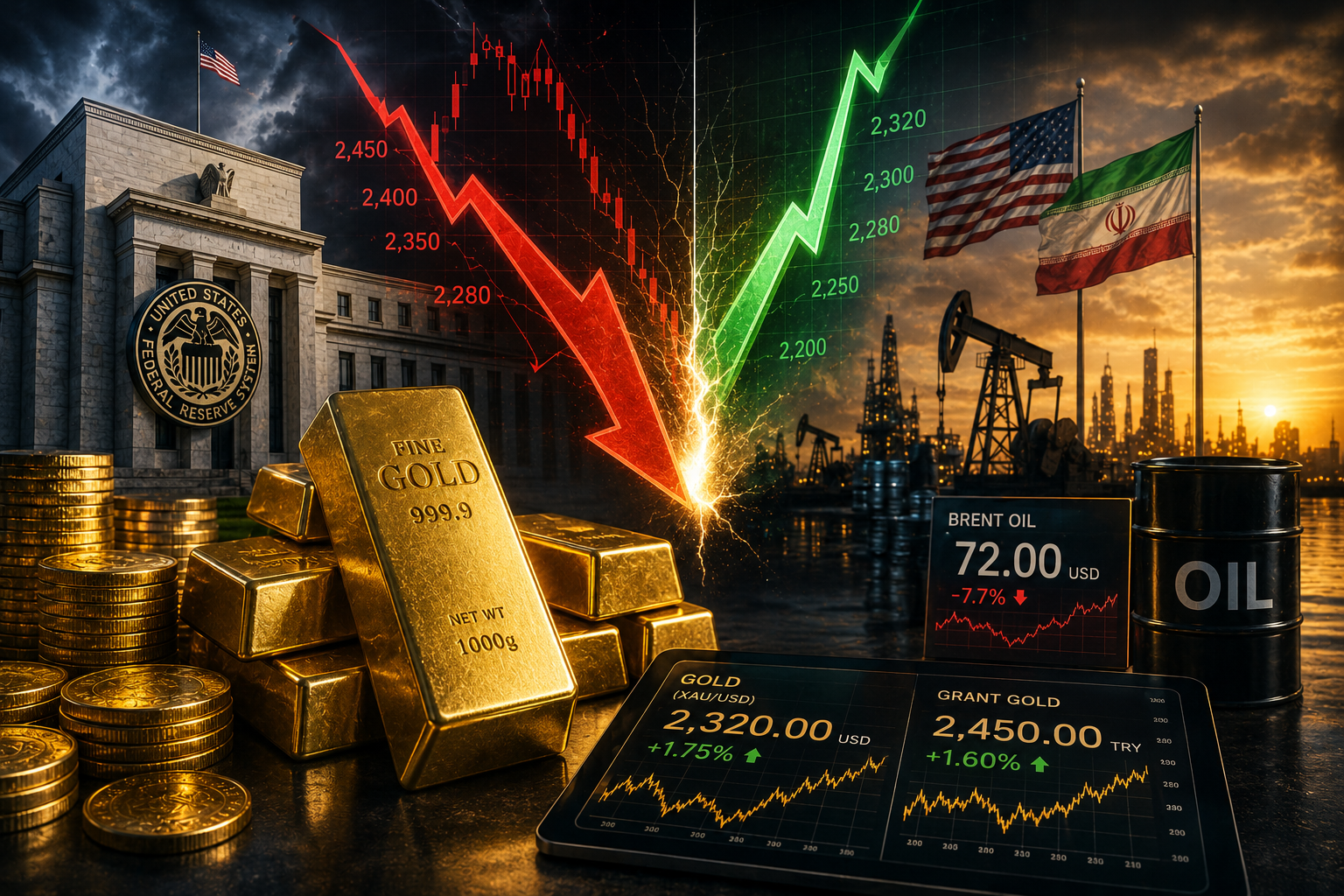
In the middle of 2026, amid global market turmoil from the Fed's hawkish moves, gold prices experienced a 'sharp turn.' After last night's unexpected statements from the Fed Chair, ounce gold plummeted, only to rebound to $2,320 today as the historic US-Iran oil deal lowered energy costs. In just a few hours, this sharp turn left investors bewildered. While the Fed's signal to raise rates to 6.75% dragged gold down to $2,280, developments in the energy market triggered a recovery. So, how did the market pulse change, and what to expect next? Here's the detailed analysis.
The Fed's Hawkish Stance and Immediate Market Reaction
Detailed Analysis of the 2026 Fed Meeting
Announced at 9:00 PM on June 18, 2026, the Fed's decisions instantly moved markets. The Fed Chair opened the door to an additional 50 basis point rate hike due to stubborn inflation at 4.8%. This statement caused ounce gold to plummet by 7% from $2,450 to $2,280. In 2025, ounce gold averaged $2,100, and had surged to $2,600 in the first quarter of 2026. Now, this sudden drop shattered investor confidence. Compared to 2025, the Fed's maneuvering room narrowed in 2026. The rate hike expectation pushed the dollar index to 107, but this made the gold dip temporary.
However, money market volatility continued. A buying wave immediately after the drop, combined with the hold of technical support levels, led gold to a sideways trend. At this point in 2026, the Fed's tightening policies clearly exert a two-way pressure on gold: rising interest rates increase opportunity costs, while global uncertainty boosts safe-haven demand.
The US-Iran Deal and the Impact of Oil Prices on Gold
Global Interaction of Geopolitical Agreements
Announced early today, the US-Iran pact directly jolted the oil market. Brent crude fell 7.7% from $78 to $72 per barrel. This drop in energy costs eased inflation expectations and indirectly benefited gold. Although gold prices typically decline when geopolitical risks recede, this time, the sharp fall in oil created a liquidity effect that pushed gold upward in a surprise move. Every $1 drop in oil prices has the potential to reduce global inflation by 0.1 percentage points, increasing gold's allure.
The news of Iran's 1.8 million barrels per day of oil exports re-entering the market sparked speculation that emerging central banks might alter their gold reserve policies. Expectations that major consumers like China and India could redirect energy savings into gold generated an additional 15-tonne demand in the spot market. This explains the mechanism behind ounce gold's recovery to $2,320.
Technical Analysis of Ounce and Gram Gold: Numerical Assessment
Support and Resistance Levels in Light of June 18, 2026 Data
Ounce gold is currently trading at $2,320, while gram gold stabilizes at 2,450 TL. Considering gram gold was at 1,800 TL in the same period of 2025, it delivers a 36% annual return. For the first half of 2026, this performance shows investors favor gold as an inflation hedge. The RSI indicator stands at 42, near oversold territory, signaling a technical correction. Technically, $2,280 is a critical support point for ounce gold, with $2,350 emerging as resistance.
For gram gold, the sideways USD/TRY rate at 32.50 is decisive. The rate moving in a 2.3% band keeps gram gold between 2,400-2,500 TL. Analysts predict ounce gold will trade in the $2,300-$2,360 range in the next 48 hours, with volume potentially reaching 1.2 million lots.
2026 Gold Strategies for Investors: When to Buy, When to Sell?
Short- and Long-Term Portfolio Recommendations
For gold investors in 2026, the critical question is how to turn these sharp turns into opportunities. Short-term traders eye buying opportunities in the $2,280-$2,320 range. Long-term strategists argue that central bank reserve diversification could push gold to $3,000 by 2027. According to the World Gold Council, central banks bought 1,200 tonnes of gold in 2025, and this trend is expected to rise by 15% in 2026. In the remainder of 2026, gold-backed ETFs are projected to see inflows of $3.2 billion.
For individual investors, we recommend keeping 10-15% of portfolios in gold and gold-backed assets. Those preferring physical gold may consider buying when gram gold drops below 2,420 TL. However, given the uncertainties around the Fed's July meeting, a staggered buying strategy is the wisest approach for now. If gold closes 2026 above $2,800, it will form a long-term buy signal.
In light of data and developments, the gold market is as we know it: opportunity and risk intertwined. Do geopolitical truces bring a lasting drop, or does gold, as always, feed on chaos? Share your views and strategies with us, let's track the market together.
