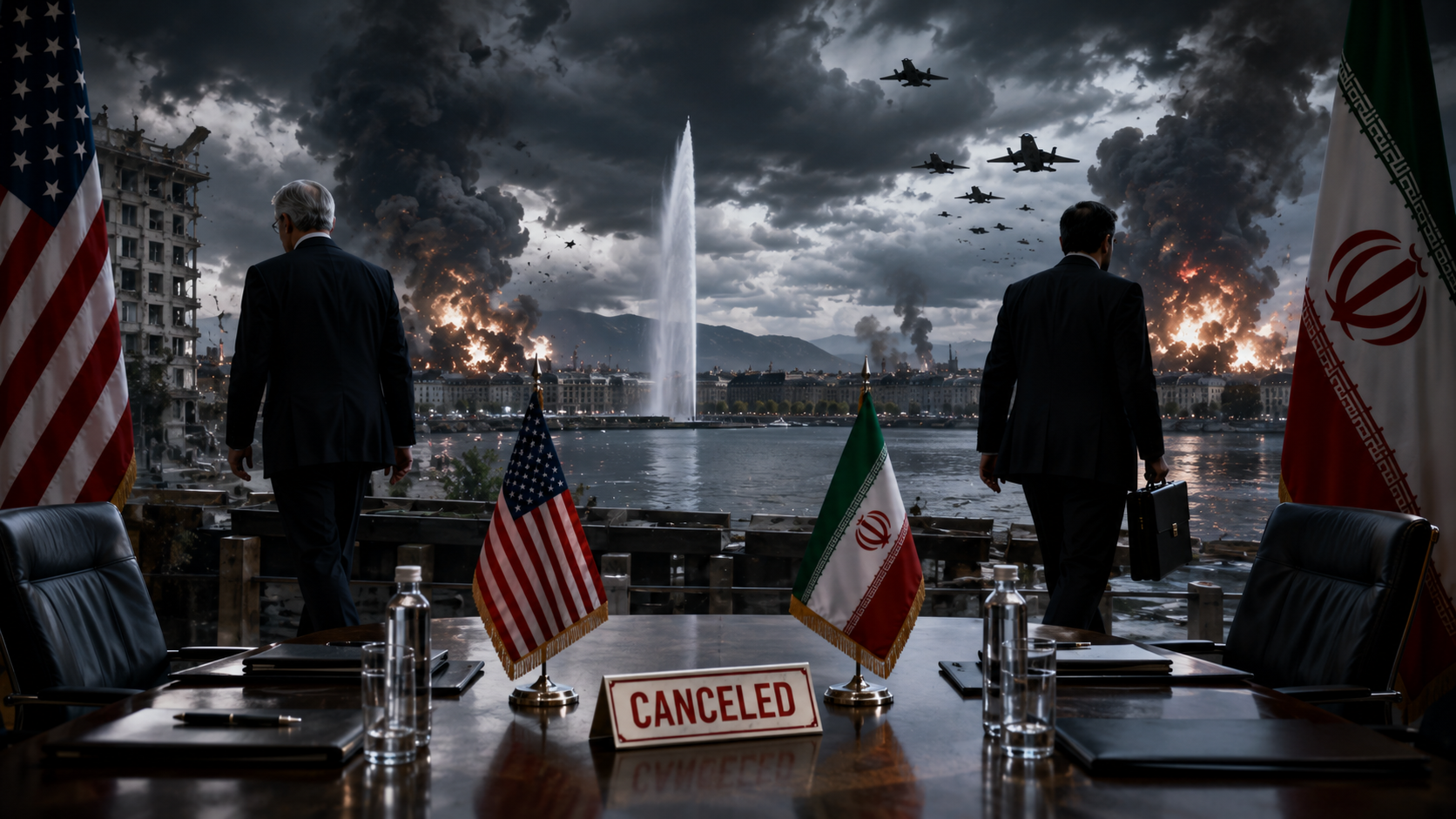
Minutes before 09:00, the hour set for diplomacy in Geneva, the news shocked world capitals: the vital negotiations between the US and Iranian delegations, aimed at ending the war and de-escalating regional tension, were canceled. The most critical diplomatic meeting of 2026 collapsed before it even began, dashing hopes of ending the conflicts that displaced hundreds of thousands in 2025 and deepened the global energy crisis. The signed memorandum still sits on the table, but a last-minute move by one side buried the fragile peace process under rubble.
The Backstage of the Last-Minute Cancellation
According to official statements, the Iranian delegation left the hotel 45 minutes before entering the conference room. The Iranian Foreign Ministry spokesperson claimed in a written statement that they 'received intelligence about the US delegation planting sophisticated electronic eavesdropping devices in the meeting room.' The US side dismissed the accusation as 'completely baseless and a pretext to sabotage the negotiation.' Although the Swiss Federal Department of Foreign Affairs attempted mediation, it was impossible to bring the parties back to the table. This incident is reminiscent of a similar protocol crisis in Vienna in 2025, where both sides traded blame.
The Critical Last-Minute Crisis in Switzerland and the Protocol Wars
This breakdown, despite the extraordinary security measures taken at the InterContinental Hotel where the meeting was to be held, underscores the depth of the trust deficit in diplomacy. Sources close to the Iranian delegation suggest that the real rupture occurred over differing interpretations of 'direct delegation contact' just before the meeting. The US's request for a bilateral pre-meeting, citing Article 4 of the memorandum, was perceived by Tehran as a 'coercive concession tactic and a divisive maneuver.' What began as a protocol war escalated sharply before the official start of the talks, leading to an abrupt halt.
The Fragile Foundations of the Signed Memorandum
The real question is why the memorandum signed with great ceremony in Oslo just 15 days ago, which foresaw the cessation of hostilities, proved so weak. A detailed analysis of the document reveals critical gaps in the three main pillars needed for a lasting solution: the ceasefire verification mechanism, the timeline for heavy weapons withdrawal, and the sequencing of sanctions relief. With the fate of Iran's 2.4 million barrel-per-day crude oil exports in the first quarter of 2026 remaining uncertain, these gaps create a constant ground for mutual accusations.
Ambiguities in the Memorandum Text and Implementation Obstacles
The vague phrasing in the secret Annex 7 of the memorandum, specifically titled 'national security interests,' constitutes the core source of the trust crisis. The US delegation argues that sanctions waivers cannot start until Iran ceases support for regional militias, while Iran insists on the immediate release of its assets frozen in 2025, which currently exceed $12 billion in value, as a precondition. This grey area in the text provided more than enough pretext for the cancellation of the critical meeting.
The Reaction of Global Markets and Regional Balances
The cancellation news triggered an immediate shockwave in global markets. The price of Brent crude oil surged 4.7% in the first 40 minutes after the news broke, climbing to $118 per barrel. The energy stocks index on the London Stock Exchange closed the day up 2.3%, while the risk premiums (CDS) for countries in the geopolitical transit belt, such as Turkey, Iraq, and the Gulf states, spiked by an average of 35 basis points. The possibility of a regional military escalation stirred up spot prices in the European natural gas market, which had not yet fully recovered from the 2025 supply crisis.
Oil Prices Soared Instantly: An Economic and Political Analysis
Iran sits at a critical chokepoint for roughly 20% of global oil transit via the Strait of Hormuz. With the collapse of the talks, claims emerged that Tehran-aligned groups could threaten tanker traffic in the Bab el-Mandeb Strait. Economists argue that if diplomacy is completely abandoned, settling oil in the $135 band by year-end and forcing inflation-fighting central banks to halt their interest rate cut cycles entirely is inevitable. The derailment of negotiations is not just a diplomatic failure; it has become a clear stagflation signal for the global economy in 2026.
From Diplomatic Crisis to the Brink of a Hot Military Conflict?
As the talks were being canceled, the positioning of the US Navy's USS Roosevelt carrier strike group in the Arabian Sea drew attention. While Pentagon officials described this as a 'routine rotation,' hardliners in Tehran interpreted the military movement as 'psychological warfare.' Ahead of Iran's presidential elections in the second half of the year, the conservative camp is expected to harden its anti-negotiation rhetoric. In an atmosphere where the diplomatic channel is completely shut, the risk of a border clash spiraling out of control and triggering a full-scale regional war is higher than ever before.
Expert Opinions: 2026 Scenarios and Future Projections
According to the International Crisis Group's (ICG) 2026 Report, if there is no remaining communication channel—even an indirect one—between the parties, an intensification of proxy wars along the Iraq-Syria line during the summer months is unavoidable. Former diplomats and regional experts suggest that mediators like Oman or Qatar, alongside Switzerland, could step in, but with the trust deficit so profound, a new memorandum of understanding in the next 6 months is almost impossible. While the world still remembers the harsh lessons of 2025, it steps into the second half of 2026 with massive distrust and uncertainty.
Has the collapse of the diplomatic table just reminded the parties of the destructive cost of war, or is it the first step towards an uncontrolled escalation? Do you think the last-chance train for regional peace has been missed?
