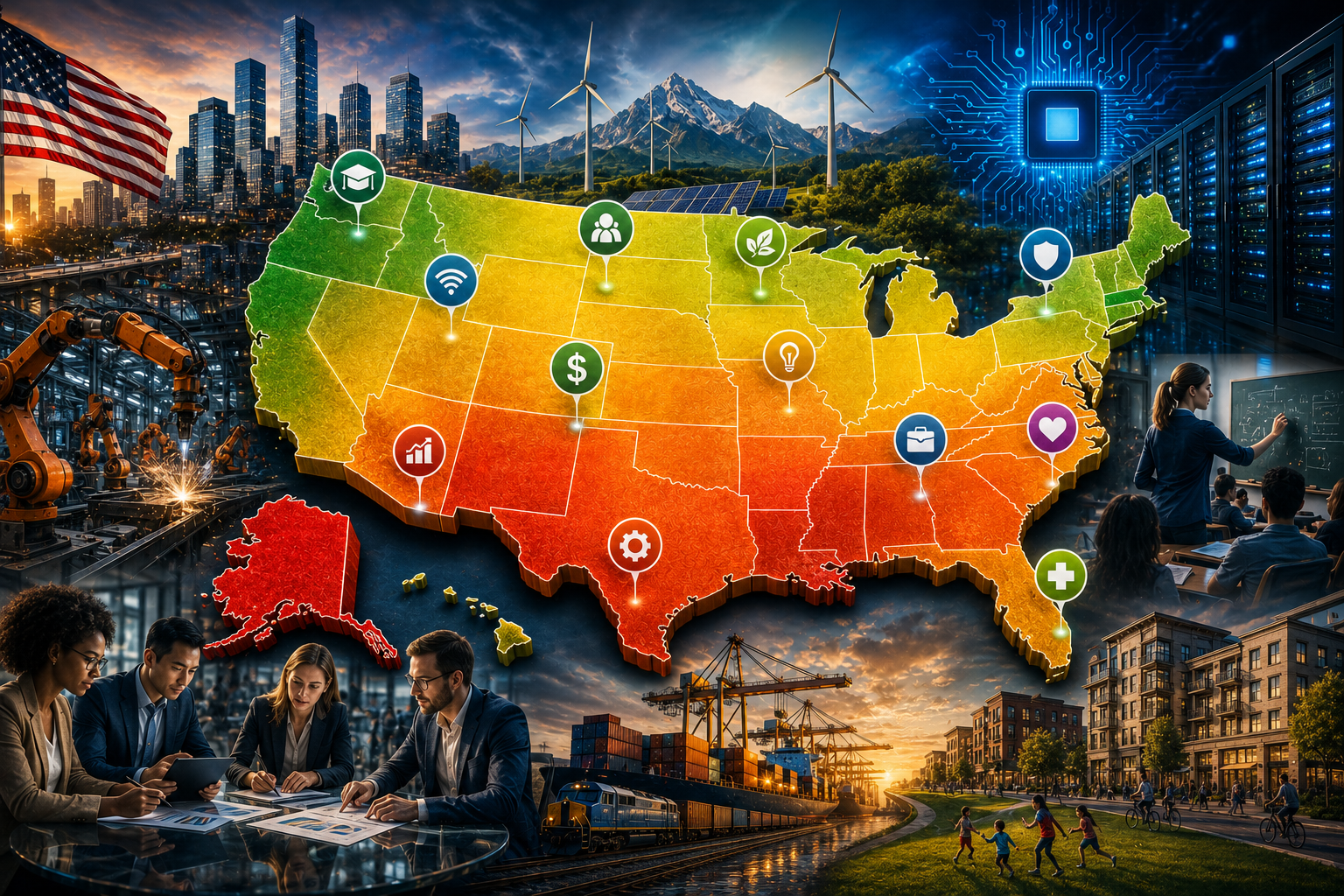
The year 2026 finds American business teetering on a knife's edge. On one side lies the boundless promise of artificial intelligence and green energy, while on the other looms a persistent skilled labor shortage, political fragmentation, and economic whiplash. To navigate this treacherous landscape, we undertook a comprehensive ranking of all 50 U.S. states, moving far beyond simplistic cost-to-operate comparisons. Our analysis dives deep into the structural resilience that separates tomorrow's winners from today's laggards.
We recalibrated our entire weighting system for 2026, responding to the aftershocks of the 2025 elections and the rewiring of global supply chains. A state's business climate is no longer defined solely by how easy it is to set up shop, but by how well it can withstand systemic shocks. The old playbook is dead; the new benchmark is adaptive capacity, and our methodology reflects this harsh new reality across 10 distinct categories.
Shifting Weights: What Truly Matters for Business in 2026
This year, 'Workforce and Talent' commands the heaviest weight at 18%. With the U.S. economy adding 2.7 million jobs throughout 2025, the bottleneck is no longer demand but supply — specifically, skills. States churning out STEM graduates and attracting specialized AI engineers are sprinting ahead, while those reliant on legacy industries falter. Close behind is 'Infrastructure and Connectivity' at 16%; a region without ubiquitous high-speed broadband and modern logistics is simply invisible in the streaming, data-hungry digital economy.
Notably, 'Cost of Doing Business' slipped from third to fourth place. As inflation cooled to 3.8%, the pressure shifted from raw cost containment to value creation. Companies are increasingly willing to pay a premium for locations that foster innovation and attract global talent, rather than chasing the lowest tax bill. This nuance pushed 'Quality of Life' into the top five with a 14% weighting, signaling that where people want to live now dictates where capital flows.
The Rise of Education and Mental Health Metrics
The most dramatic methodological shift is the elevation of 'Education' from 8% to 12%. A high school diploma is no longer a sufficient workforce foundation; our scoring now rigorously evaluates vocational training pipelines and university-industry patent partnerships. Furthermore, we introduced a novel sub-metric: 'Access to Mental Health Services.' In a post-pandemic world grappling with burnout, a state's healthcare infrastructure has become a hard-nosed economic variable affecting productivity and retention.
Similarly, 'Environmental Sustainability' cracked the top-ten criteria for the first time. New federal carbon-footprint regulations mean weak state-level green policies are now a direct liability. Our data shows that companies operating in states with lax environmental oversight are beginning to face tangible export penalties in European markets. Clean energy capacity is no longer a virtue signaling exercise; it is a trade requirement.
The AI Disruption: How Automation is Redrawing the Map
Artificial intelligence acts as the invisible hand of our 2026 rankings. A state’s 'AI Readiness' score — a composite of patent density, data center capacity per capita, and machine learning engineer concentration — is a powerful predictor of economic momentum. Interestingly, states with high 'automation exposure' (heavy concentration of repetitive manufacturing) have tumbled in the rankings, while those aggressively forming public-private partnerships to reskill workers are climbing.
While 2025 saw roughly 400,000 jobs displaced by AI, 2026 is projected to generate a net positive of 1.2 million new roles centered on AI oversight and development. Our methodology captures this churn through an 'Innovation Economy' pillar, grading states on the velocity of their startup ecosystems, venture capital inflows, and the effectiveness of their technology transfer offices in commercializing university research.
The Boom of Secondary Cities and Housing Crises
A defining trend of 2026 is the permanence of remote work elevating secondary and mountain-region cities. Tech workers freed from coastal office mandates are chasing natural beauty and lower density. However, this migration has triggered a 'overheating' risk. With housing prices surging 35% year-over-year in some formerly quiet towns, we had to place 'Housing Affordability' at the absolute center of our Quality of Life scoring. A state cannot sell itself as a haven for talent if nurses and teachers cannot afford to live there.
This dynamic has given a surprising boost to legacy industrial states in the Rust Belt. By converting abandoned factory spaces into mixed-use housing and co-working hubs, they are turning an infrastructure curse into a competitive advantage. Our methodology now rewards this adaptive reuse of industrial heritage, recognizing that the bones of the old economy can house the workers of the new.
Policy Climate: When Social Law Becomes Economic Reality
In 2026, the political environment has hardened into a direct balance-sheet factor. Social legislation regarding reproductive rights, LGBTQ+ protections, and educational curriculum directly impacts a corporation’s ability to import a diverse, top-tier workforce. For the first time, we introduced an 'Inclusivity Index' that aggregates the strength of anti-discrimination laws, the prevalence of corporate diversity reporting, and hate crime statistics into a single, hard score that affects the overall ranking.
Tax incentives remain potent, but a senior software engineer simply will not relocate — even for a $300,000 salary — to a state where they feel fundamentally unsafe or unwelcome. A 2025 survey confirmed that 68% of tech workers view social policy as a decisive factor in job mobility. We have therefore stripped out generic 'Regulatory Framework' metrics and replaced them with these qualitative, consequence-driven datasets that mirror genuine corporate relocation conversations.
Grid Reliability and the Green Premium
The final critical pillar is energy. Extreme weather events in 2025 elevated grid reliability to a status rivaling corporate tax rates. For a manufacturing facility, suffering three days of outages a week due to a brittle grid is an unacceptable operational risk. States investing heavily in renewables are rising not just for their green credentials, but because solar and wind contracts offer long-term price predictability in a volatile energy market. Our methodology heavily weights battery storage capacity alongside generation, rewarding the states building the resilient micro-grids of tomorrow.
Ultimately, the 2026 ranking is a guide to resilience, not just cost. It reflects a shift from a 'race to the bottom' on expenses to a 'race to the top' on adaptability. The states topping our list are those that can protect their businesses from the next climate shock, technological disruption, or political rupture. The question is no longer 'how cheap is it to be here?' but 'can this state carry me through the next crisis?'
So, which arena matters most to your enterprise? Are you a startup chasing the raw edge of AI, or a manufacturer seeking an unbreakable supply chain? Before you expand or relocate, examine which of these 10 categories represents an existential risk — or an unmissable opportunity — for your specific sector.
