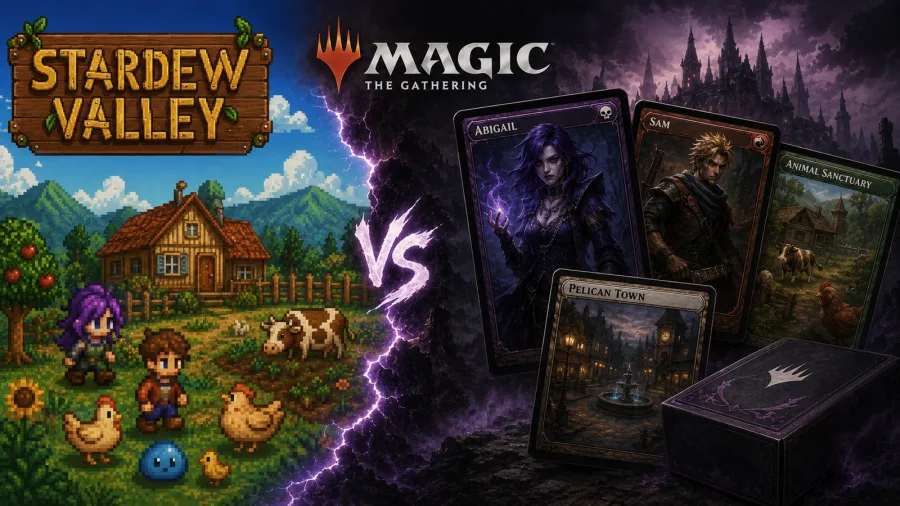
The pastoral peace of Pelican Town has collided with the multiverse of Magic: The Gathering, and the resulting shockwave is reverberating through both fan communities in July 2026. Wizards of the Coast, the Renton, Washington-based subsidiary of Hasbro, recently unveiled its latest Secret Lair drop, a crossover with Eric Barone's beloved farming simulator Stardew Valley. What was intended as a charming homage has instead ignited a firestorm of criticism, with fans accusing the card game giant of fundamentally misunderstanding the visual soul of the indie classic.
A Clash of Aesthetics: Pastoral Meets Gothic
The core of the controversy lies in the radical artistic reinterpretation of Stardew Valley's iconic characters. The game, first released in 2016, is celebrated for its warm, inviting pixel art — a deliberate choice by its sole creator, ConcernedApe, to evoke nostalgia and comfort. The new MTG cards, however, apply the house style of Magic's fantasy artists, which leans heavily towards detailed, gritty, and often dark realism. The result is a jarring visual dissonance. Characters who once exuded pixelated charm now appear with hardened expressions and shadowed features, as if they had been transported from a sunny valley into a gothic horror plane like Innistrad.
Nowhere is this disconnect more apparent than in the depiction of Abigail, the adventurous, video-game-loving villager with distinctive purple hair. In her MTG card art, she is rendered as a stern, almost menacing sorceress, her features sharp and her gaze unsettling. Similarly, Sam, the easygoing musician and skateboarder, appears as a brooding warrior. The community's reaction was swift and merciless. Across platforms like Reddit's r/StardewValley and various MTG forums, players expressed a sense of betrayal, arguing that the new art strips the characters of their identity and replaces it with a generic, grimdark aesthetic that feels entirely alien to the source material.
The Secret Lair Strategy and Collector Culture
To understand the backlash, one must examine the product itself. Secret Lair drops are a unique distribution model for Magic: The Gathering, offering limited-time, direct-to-consumer sets that are primarily reskins of existing, mechanically functional cards. This model allows Wizards of the Coast to experiment with external intellectual properties (IPs) without impacting the standard game's meta. The Stardew Valley drop features cards like 'Animal Sanctuary' and 'Pelican Town,' representing in-game elements on the cardboard of known MTG spells and creatures. It is a purely cosmetic collector's item, and this is precisely where the tension peaks.
Despite the widespread aesthetic criticism, the financial mechanics of Secret Lair are likely to ensure the product's commercial success. The secondary market for rare MTG cards has seen a significant uptick in the second quarter of 2026, and limited-print crossover sets have historically appreciated in value. This creates a collector's dilemma: a product loathed for its art may still be purchased as a speculative investment. This dynamic has added a layer of cynicism to the discourse, with some commentators noting that Wizards of the Coast's business model is now insulated from artistic failure by the speculative fervor of the collector market. The controversy has, paradoxically, amplified the set's visibility, a phenomenon not lost on industry analysts observing the hype cycle of modern gaming merchandise.
Fan Identity and the Psychology of Nostalgia
The intensity of the fan reaction underscores a profound psychological connection between players and the virtual worlds they inhabit. Stardew Valley is not merely a game about farming; for its millions of players, it serves as a digital sanctuary, a therapeutic escape from the anxieties of modern life. The residents of Pelican Town are perceived not as lines of code, but as friends, neighbors, and even romantic partners. A 2025 study on gaming and emotional attachment by the Oxford Internet Institute highlighted how deeply players integrate such characters into their personal narratives. Consequently, a radical visual redesign can feel like a personal violation, tarnishing cherished memories and altering a deeply personal headcanon.
From the MTG community's perspective, however, the outrage can seem disproportionate. Magic has a long history of re-contextualizing its own characters and planes through different artistic lenses, from anime-style variants to noir-inspired treatments. For a seasoned Magic player, a Secret Lair drop is an invitation to see a familiar game piece through a new, often experimental, artistic filter. This fundamental difference in consumer expectation—between a community that values a single, cohesive artistic vision and one that celebrates a multiverse of visual interpretations—lies at the heart of the conflict. The Stardew Valley crossover has become an unexpected cultural flashpoint, highlighting the challenges of merging a monolithic, creator-driven indie game with a sprawling, corporate-managed franchise.
The Future of Crossovers in a Fractured Media Landscape
As of mid-2026, the gaming and entertainment industries are saturated with crossover events, from Fortnite's metaverse of characters to the cinematic multiverses of Marvel and DC. The Stardew Valley MTG incident serves as a critical case study in how these partnerships can go awry. It proves that brand synergy cannot be forced through a simple licensing agreement; it requires a deep, empathetic understanding of what each property represents to its audience. The failure here was not a lack of technical skill—the MTG artists are undoubtedly talented—but a failure of tonal alignment. The project prioritized the visual language of the host brand (MTG) over the emotional language of the guest brand (Stardew Valley).
Looking ahead, the path to successful crossovers likely involves a more collaborative and transparent process. Future projects might benefit from involving the original creators more deeply in the art direction or by presenting multiple artistic concepts to the fanbase for feedback before finalizing a product. For now, the Stardew Valley Secret Lair stands as a monument to a missed opportunity—a meeting of two beloved worlds that, instead of creating a beautiful harmony, resulted in a discordant note. As the cards ship to buyers around the globe this summer, they will carry with them not just the spirit of the valley, but the weight of a community's profound sense of loss for a world they thought they knew.
