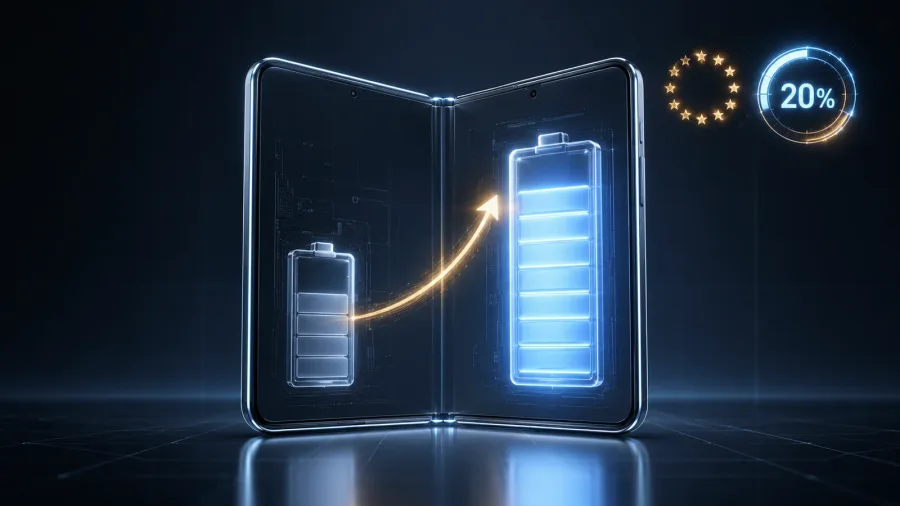
Samsung appears poised to tackle one of the most persistent criticisms of its premium foldable lineup with the Galaxy Z Fold 8 series. New battery certifications filed with European Union regulatory bodies reveal two distinct power packs that point to a roughly 20 percent capacity increase over the current generation, a leap that could fundamentally alter the daily usability equation for foldable smartphones. The documents, spotted in the EU's mandatory product certification database in July 2026, suggest the South Korean electronics giant is preparing a significant hardware upgrade ahead of its expected late-summer launch window.
The Galaxy Z Fold 7, which debuted in 2025, shipped with a 4400 mAh battery that struggled to deliver a full day of intensive use on its expansive 7.6-inch main display. The newly certified battery packs, carrying model numbers EB-BF959ABE and EB-BF959ABY, indicate the Z Fold 8 could reach the 5250 mAh threshold, while the rumored Ultra variant might push even further toward 5500 mAh. This represents the most substantial year-over-year battery improvement in the history of Samsung's foldable lineup and addresses what consumer surveys consistently rank as the number one pain point for foldable adopters.
The timing of this upgrade is strategically significant. Chinese competitors including Honor and Xiaomi have been aggressively marketing their own foldable devices with silicon-carbon battery technology that delivers superior energy density without increasing physical dimensions. Honor's Magic V4, launched earlier in 2026, set a new benchmark with its 5600 mAh cell, putting pressure on Samsung to respond. The EU filings strongly suggest Samsung Display and Samsung SDI have collaborated on integrating silicon-carbon anode technology into the Z Fold 8 series, a move that would bring the company's battery chemistry in line with the most advanced offerings on the market while leveraging Samsung's superior quality control and safety testing protocols.
The global foldable market shifts its focus toward endurance
The foldable smartphone segment has matured considerably by 2026, with global shipments projected to exceed 50 million units by year-end. What began as an experimental form factor has evolved into a legitimate premium alternative to traditional slab flagships, and the criteria for success have shifted accordingly. Early adopters were willing to tolerate compromises in battery life for the novelty of a folding screen, but mainstream consumers now demand parity with conventional devices. Samsung commands approximately 58 percent of the global foldable market, but that dominance is under pressure from rivals who have identified battery endurance as the vulnerability in Samsung's armor.
European consumers, who represent the largest foldable market outside of Asia, have shown particularly strong sensitivity to battery performance. Market research conducted across Germany, France, and the United Kingdom in early 2026 indicates that 71 percent of potential foldable buyers rank battery life as either their first or second most important consideration, trailing only device durability. Samsung's ability to maintain IPX8 water resistance while simultaneously increasing battery capacity demonstrates the engineering maturity the company has achieved after six generations of foldable devices. This dual achievement — better endurance without sacrificing protection — could prove decisive in retaining market share against increasingly capable Chinese alternatives.
In the United States, carrier partnerships remain the backbone of foldable distribution, and battery life figures prominently in retail sales conversations. Verizon and T-Mobile representatives, speaking on background, have indicated that the 'two-day battery' marketing claim — which becomes viable at the 5250 mAh threshold — significantly improves attach rates during in-store demonstrations. The Z Fold 8's battery improvements could therefore translate directly into higher sales volumes through the carrier channel, where subsidized pricing already makes foldables more accessible to mainstream American consumers.
Silicon-carbon battery technology explained
The shift from traditional lithium-ion cells with graphite anodes to silicon-carbon chemistry represents one of the most consequential advances in mobile power storage in recent years. Silicon can theoretically store up to ten times more lithium ions than graphite during charging, dramatically increasing energy density without requiring larger physical dimensions. The practical challenge — and the reason this technology has been slow to reach mass-market devices — lies in managing the significant volumetric expansion that silicon undergoes during charge cycles, which can lead to premature degradation and safety concerns.
Samsung SDI, the conglomerate's battery manufacturing arm, has reportedly solved these challenges through a composite anode structure that blends silicon nanoparticles with a carbon matrix, allowing for controlled expansion while maintaining structural integrity over hundreds of charge cycles. The company's internal testing protocols, which exceed industry standards for thermal runaway prevention and long-term capacity retention, give Samsung a competitive advantage in deploying this technology at scale. The Z Fold 8 will likely be the first Samsung mobile device to feature this battery chemistry, positioning it as a technology demonstrator for future Galaxy S and Galaxy A series devices.
What the EU certifications actually reveal
The European Union's CE certification database requires manufacturers to register battery components for all devices sold within the bloc, making it one of the most reliable sources for pre-launch hardware intelligence. The two Samsung battery packs that surfaced in July 2026 carry the naming convention consistent with Galaxy Z Fold series components, and their rated capacities align with the expected progression from the Z Fold 7's 4400 mAh unit. The presence of two distinct part numbers strongly corroborates earlier supply chain reports that Samsung plans to launch both a standard Z Fold 8 and a higher-end Z Fold 8 Ultra variant in 2026.
Industry analysts interpreting the filings note that the rated capacities — which typically differ slightly from the 'typical' capacities marketed to consumers — suggest final figures of approximately 5250 mAh for the standard model and up to 5500 mAh for the Ultra. The Ultra's larger battery, combined with what is expected to be a slightly larger external display and potentially a 200-megapixel main camera sensor, positions it as a direct competitor to Honor's range-topping foldable while maintaining Samsung's software ecosystem advantages, including DeX desktop mode and seamless integration with the Galaxy Watch and Galaxy Buds accessory lines.
Charging speeds, however, appear to remain conservative. The certifications do not indicate a move beyond 45W wired charging, a threshold Samsung has maintained for several generations. Wireless charging may see a modest bump to 25W, while reverse wireless charging for accessories is expected to stay at 9W. This deliberate pace on charging speed — in contrast to Chinese manufacturers who have pushed beyond 100W — reflects Samsung's prioritization of long-term battery health and thermal management over headline-grabbing peak power figures.
Implications for the Turkish premium smartphone segment
Turkey's smartphone market has shown remarkable appetite for foldable devices despite challenging economic conditions and import duties that push flagship prices well above 100,000 Turkish lira. Samsung Turkey's distribution network, which includes partnerships with major electronics retailers and all three mobile operators, has successfully positioned the Z Fold series as the ultimate status symbol and productivity tool for the country's business elite. The battery improvement in the Z Fold 8 addresses a specific pain point for Turkish professionals who frequently travel between Istanbul, Ankara, and Izmir and cannot always rely on consistent access to power outlets.
Consumer research conducted by Turkish technology publications indicates that battery anxiety ranks even higher among Turkish foldable users than the global average, with 74 percent citing it as a primary concern. The country's occasional power grid instability in certain regions adds a practical dimension to battery endurance that goes beyond convenience. Samsung Turkey's trade-in programs, which have been particularly generous for foldable upgrades, are expected to make the Z Fold 8 accessible to existing Z Fold 5 and Z Fold 6 owners at a reduced effective price, potentially accelerating the upgrade cycle in this high-value customer segment.
The broader vision for Samsung's foldable future
The Z Fold 8's battery upgrade is best understood as one piece of a larger strategic puzzle. Samsung is simultaneously working on reducing the visible crease on its folding displays, slimming down the overall device thickness, and expanding the cover screen's usability — all while maintaining the premium build quality and IPX8 water resistance that differentiate its foldables from cheaper alternatives. The battery improvement enables these other advances by providing the power headroom necessary to drive brighter, more efficient displays and more powerful chipsets without compromising endurance.
Samsung's long-term vision, articulated at its 2026 Developer Conference in San Francisco, positions foldables as the eventual replacement for both smartphones and small tablets within its ecosystem. Achieving that vision requires eliminating every remaining compromise that might cause a consumer to choose a conventional Galaxy S Ultra over a Z Fold. Battery life has historically been the most significant of those compromises, and the Z Fold 8's silicon-carbon power pack represents the most direct assault yet on that barrier. If Samsung executes successfully, the Z Fold 8 could mark the inflection point where foldables transition from early-adopter curiosity to mainstream default, reshaping the mobile industry landscape for the remainder of the decade.
