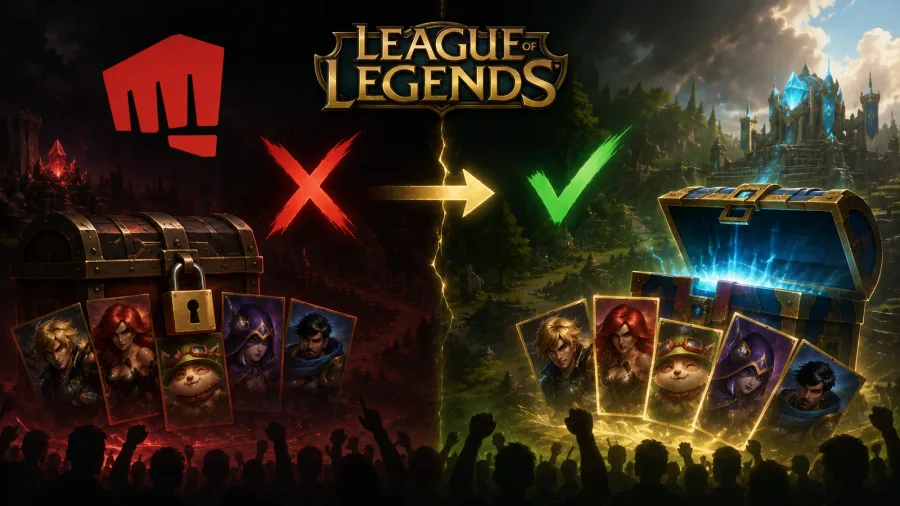
Riot Games, the California-based developer behind the world's most popular MOBA, has reversed a controversial monetization plan for its newly launched League of Legends Classic mode within 48 hours. The decision to charge players for legacy skins sparked immediate and overwhelming backlash from one of gaming's largest communities, forcing an unusually swift corporate retreat in July 2026.
The Classic mode, which rolled out in beta during the second week of July 2026, promised to transport players back to the game's 2009 origins. By stripping away over a decade of champion additions, reworks, and item overhauls, the mode aimed to recreate the raw, unbalanced, but beloved early days of League of Legends. The controversy erupted when players discovered that the accompanying legacy skins—visual designs from that same era—were locked behind a paywall. For a community that had been asking for a genuine return to the past, the idea of paying again for content they once owned or associated with a free experience felt like a betrayal of the mode's core promise.
The reaction was immediate and ferocious. Within hours, the subreddit r/leagueoflegends became a hub of coordinated criticism, with top posts dissecting the economic logic behind charging for nostalgia. One widely shared comment captured the sentiment: 'The entire point of Classic is to relive the past, not to repurchase it.' The backlash quickly spilled over to X (formerly Twitter) and Twitch streams, where prominent esports figures and content creators amplified the message. Riot, a company known for its methodical and often slow response to community feedback, found itself in an uncharacteristically urgent crisis management situation.
An uncharacteristically rapid corporate about-face
Andrei van Roon, a senior executive on the League of Legends team, issued a statement on the official LoL social media channels that signaled a complete capitulation to player demands. 'All legacy skins in Classic mode will be fully unlocked and free for every player who accesses the mode,' van Roon wrote, acknowledging that the initial plan 'did not align with the nostalgic spirit of the player experience we aimed to deliver.' The statement was notable not just for its content, but for its speed and tone—direct, apologetic, and devoid of the usual corporate hedging.
This rapid reversal stands in stark contrast to Riot's historical approach to controversy. The company has often weathered storms of criticism over balance changes, esports decisions, and even previous monetization strategies with a more measured, long-term response. The urgency displayed in this case suggests that internal metrics may have flashed warning signs almost immediately. Player engagement with the Classic mode, which was designed to re-engage lapsed veterans and attract curious newcomers, likely plummeted as news of the paid skins spread. For a game that has seen a gradual decline in its active player base through 2025 and into 2026, the stakes for a successful nostalgia-driven revival could not have been higher.
The broader context of nostalgia monetization
The LoL Classic controversy does not exist in a vacuum. It follows a well-established pattern in the gaming industry where companies attempt to monetize nostalgic content, only to face fierce resistance. In 2025, Activision Blizzard encountered similar criticism when it experimented with premium pricing for certain legacy items in World of Warcraft Classic. That incident, like Riot's, ended with a swift rollback. The lesson appears to be crystallizing: players view nostalgia as a communal, shared heritage, not a commodity to be resold. When a mode's entire value proposition is 'returning to the good old days,' any attempt to gate parts of that experience behind a paywall is perceived as a violation of the implicit social contract between developer and community.
Industry analysts have noted that 2026 marks a turning point in how live-service games approach their veteran player bases. With the global gaming market surpassing $200 billion, the competition for player attention and loyalty is fiercer than ever. Nostalgia-driven content has become a key retention strategy, but its success hinges on authenticity and generosity. Riot's misstep and subsequent correction provide a case study for other developers: the goodwill generated by a free, complete nostalgic experience far outweighs the short-term revenue from microtransactions within that experience. The long-term health of the player ecosystem depends on trust, and trust is built by giving, not by taking.
The economics of retreat: why Riot chose goodwill over revenue
From a purely financial perspective, Riot's decision to make all legacy skins free in Classic mode represents a significant short-term revenue sacrifice. League of Legends generates an estimated $1.8 billion annually, with the vast majority coming from cosmetic skin sales. The Classic mode, with its dedicated and passionate target audience, could have been a lucrative new revenue stream. However, the calculus that led to the reversal was almost certainly driven by lifetime value projections. A player who feels respected and valued is more likely to remain engaged with the broader League ecosystem, spending money on the main game, watching esports, and participating in the community.
The decision also reflects a maturing understanding of player psychology in the games-as-a-service era. The 2026 gaming landscape is saturated with battle passes, seasonal content, and cosmetic shops. Players have become adept at identifying when they are being 'nickel-and-dimed,' and they are increasingly willing to organize and protest. Riot's quick backpedal can be seen as a recognition that the reputational damage from being labeled as exploitative would have far exceeded any revenue gained from legacy skin sales. The company chose to protect its brand equity and community trust, assets that are far harder to rebuild than a quarterly revenue target is to adjust.
The evolving power of organized player communities
The League of Legends community's ability to force a multi-billion dollar corporation to reverse a policy decision within two days is a testament to the structural power of modern gaming audiences. Unlike the fragmented player bases of the past, today's communities are hyper-connected through Reddit, Discord, X, and Twitch. A resonant critique can achieve critical mass in hours, creating a PR crisis that demands an immediate response. The 'why should I pay again for what I already owned' argument was not just emotionally compelling; it was logically airtight, making it impossible for Riot to defend its position without appearing out of touch.
Esports professionals and streamers played a crucial amplifying role in this dynamic. When a prominent LEC coach criticized the policy on a live broadcast, the clip circulated widely, lending institutional weight to the grassroots outrage. This convergence of community sentiment and influencer opinion created a pressure cooker that Riot could not ignore. The incident reinforces a broader trend in the gaming industry: the line between 'community feedback' and 'corporate crisis' has never been thinner, and companies must be prepared to respond with unprecedented speed and humility when that line is crossed.
What lies ahead for League of Legends Classic
With the monetization controversy behind it, the Classic mode can now focus on its core mission: delivering an authentic, unadulterated trip back to 2009 League of Legends. The mode restores original champion kits, item builds, and map textures that have long since been patched out of the main game. For players who first picked up the game in university dorm rooms over a decade ago and are now in their 30s, the experience is a powerful nostalgia trigger. The absence of modern complexities—no elemental drakes, no mythic items, no reworked champions—offers a purity that many veterans have been craving.
Riot has indicated that the full launch of Classic mode is planned for the final quarter of 2026, with the beta period serving as a crucial testing ground for both technical stability and community sentiment. The company has also announced that additional free content, including exclusive icons and emotes, will be bundled with the mode at launch as a gesture of goodwill. The key question now is whether Classic can succeed as a long-term retention tool. Early engagement metrics from the beta are reportedly strong, but the true test will be whether the mode can hold player attention beyond the initial wave of nostalgia, offering a compelling alternative to the ever-evolving main game rather than a brief, sentimental detour.
Ripple effects across the global gaming industry
Riot's experience with League of Legends Classic is being watched closely by other major players in the games-as-a-service space. Companies like Epic Games, Valve, and Blizzard are all navigating their own nostalgia-driven projects and legacy content strategies. The emerging consensus from the 2025-2026 cycle of similar incidents is clear: when a mode or product is marketed around the concept of 'going back,' the path back must be free of new toll booths. Players are drawing a firm line between acceptable monetization in forward-looking live service games and unacceptable monetization in nostalgia-focused experiences.
The incident also highlights a broader philosophical shift in the developer-player relationship. The era of companies dictating terms to a captive audience is fading. In its place is a more negotiated, dynamic relationship where community sentiment can rapidly alter corporate strategy. For Riot Games, the Classic mode controversy will likely be remembered not as a failure, but as a moment when the company demonstrated its ability to listen and adapt. That reputation for responsiveness, if maintained, could prove more valuable in the competitive 2026 gaming market than any number of paid skin sales. As the industry continues to evolve, the companies that thrive will be those that understand a simple truth: nostalgia is a gift players give themselves, not a product to be sold back to them.
