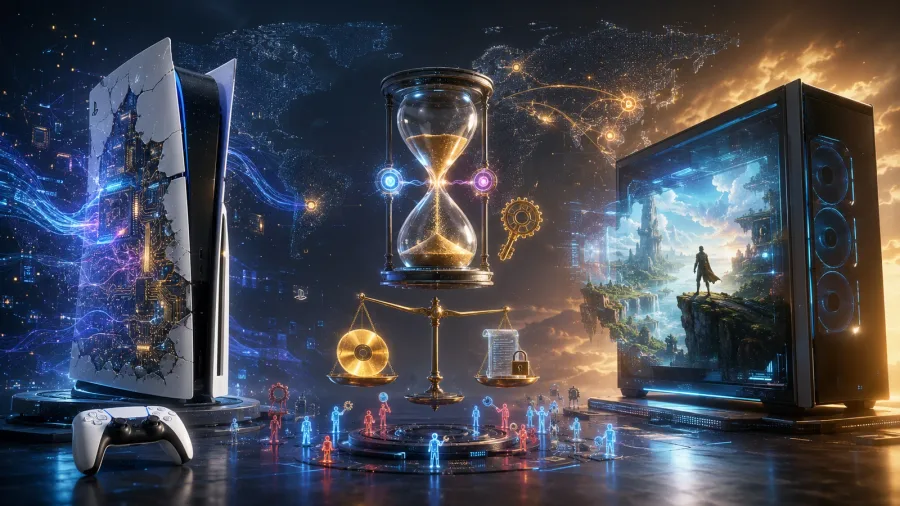
In a breakthrough that reshapes the landscape of console emulation, developers working on PlayStation 5 emulators have successfully booted a commercial PS5 game on PC for the first time in July 2026. The achievement marks the culmination of six years of painstaking reverse engineering since Sony launched its ninth-generation console, and it raises profound questions about game preservation, digital rights, and the future of platform exclusivity.
Six years of reverse engineering finally pay off
When Sony released the PlayStation 5 in November 2020, the emulation community knew it faced an unprecedented challenge. The console's custom AMD Zen 2 CPU with RDNA 2 graphics architecture represented a significant leap in complexity compared to the x86-based PS4. Early efforts in 2023 and 2024, led by open-source projects like Kyty and RPCSX, managed only basic homebrew applications and system menu navigation, leaving commercial games firmly out of reach.
The turning point came in 2025, when developers made critical breakthroughs in understanding the Orbis OS kernel, Sony's FreeBSD-based operating system. Documentation of memory management subsystems and the GPU scheduler accelerated progress dramatically. By early 2026, the emulation scene was buzzing with anticipation as developers shared incremental victories in private forums. The July 2026 milestone—running an actual commercial title from start to finish—validated years of volunteer effort and opened the floodgates for further development.
The Kyty vs. RPCSX race that accelerated PlayStation 5 emulation
The healthy competition between two major open-source projects proved instrumental in reaching this milestone. Kyty's developers focused on low-level system calls and kernel emulation, while the RPCSX team concentrated on graphics API translation layers. Rather than fragmenting efforts, this division of labor created complementary breakthroughs that ultimately converged in mid-2026, enabling the first commercial game to boot successfully.
What booting a commercial game actually means for emulation
The game in question—reportedly an indie title rather than a AAA blockbuster—ran at approximately 30 frames per second on high-end PC hardware. While this performance level falls short of the console's native 60 FPS target, it demonstrates that Sony's hardware-based copy protection and proprietary APIs are no longer insurmountable barriers. The achievement proves the conceptual viability of PS5 emulation, even if practical, full-speed gameplay remains years away.
The development community has been careful to manage expectations. Running graphically intensive titles like God of War Ragnarök or Horizon Forbidden West at playable speeds will require extensive optimization of shader compilation, texture streaming, and the GPU translation layer. Current estimates suggest that 2028 or later is a realistic timeline for AAA compatibility, assuming the current pace of volunteer-driven development continues.
The performance roadmap: From indie games to blockbusters
Emulator developers project a gradual expansion of the compatible game library through late 2026 and into 2027. Smaller titles with simpler rendering pipelines will likely lead the way, while games that leverage the PS5's custom SSD architecture and advanced haptic features present unique technical hurdles. The community's track record with RPCS3—the PlayStation 3 emulator that now runs thousands of titles—suggests patience will ultimately be rewarded.
Game preservation versus legal realities in 2026
The emulation breakthrough arrives at a moment when the video game industry is grappling with its preservation crisis. A landmark 2025 report from the Video Game History Foundation revealed that 87% of games released before 2010 are no longer commercially available. Against this backdrop, emulators have gained legitimacy as essential archival tools, with even some publishers acknowledging their role in maintaining access to abandoned titles.
Sony's legal response remains the elephant in the room. The company historically pursued aggressive litigation against emulators, including landmark cases against Bleem! and Connectix in the late 1990s. However, the legal landscape has shifted significantly by 2026. The U.S. DMCA and EU digital single market directives now provide clearer frameworks for reverse engineering, while courts have generally upheld the legality of emulators when they do not distribute copyrighted BIOS files or encourage piracy.
Sony's strategic silence and the subscription model shift
Industry analysts suggest Sony's muted response reflects a strategic pivot. The company's PlayStation Plus Premium subscription service, which offers a catalog of classic games, represents an official channel for legacy content. Rather than fighting emulators in court—a battle that generates negative publicity and is increasingly difficult to win—Sony appears to be competing through its own ecosystem, betting that convenience and official support will keep most players within its walled garden.
What PS5 emulation means for global game access
In markets where console hardware remains prohibitively expensive, emulation represents a gateway to gaming experiences otherwise out of reach. Countries facing currency devaluation and import restrictions—including Turkey, where a PlayStation 5 console costs over 40,000 Turkish lira (approximately $1,200) in 2026—stand to benefit disproportionately from successful emulation. The democratization of access to Sony's exclusive library could reshape gaming demographics in emerging markets.
Independent developers, meanwhile, view emulation through a dual lens. While piracy concerns are legitimate, many smaller studios recognize that emulators expand their potential audience beyond the console's installed base. A game that sells 50,000 copies on PS5 could reach millions of additional players through emulation, potentially driving long-tail revenue through legitimate purchases and word-of-mouth discovery.
The developer's dilemma: Piracy fears versus audience expansion
The tension between protecting intellectual property and maximizing reach has no easy resolution. Some developers advocate for official PC ports as the best defense against emulation-driven piracy, while others explore innovative business models like free-to-play with cosmetic microtransactions that naturally discourage unauthorized copies. The emulation milestone of 2026 may accelerate these conversations across the industry.
