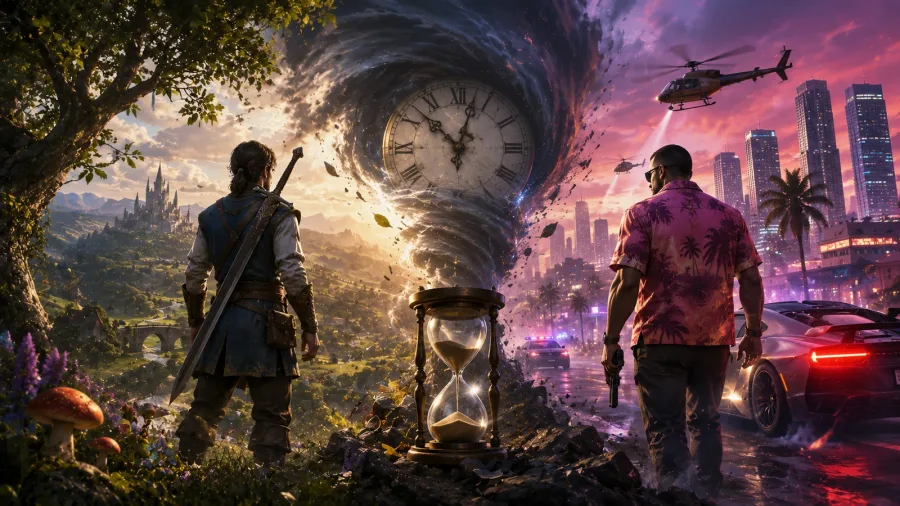
As the gaming industry navigates the unprecedented disruption caused by Rockstar's Grand Theft Auto VI, one of Xbox's most anticipated exclusives finds itself in an increasingly precarious position. The Fable reboot, developed by Forza Horizon studio Playground Games, is facing mounting pressure to avoid a collision with the industry's biggest title — and according to prominent insider Jeff Grubb, a delay beyond 2026 is now a very real possibility. With new Xbox leadership at the helm and a development team venturing into unfamiliar RPG territory, the beloved franchise's return hangs in a delicate balance.
The GTA 6 gravity well: how Rockstar's juggernaut reshapes release calendars
When Grand Theft Auto VI launched in late 2025, it didn't just break records — it fundamentally altered the economics of the entire video game industry. Generating over $1 billion in revenue within its first 24 hours, the title has maintained an iron grip on player attention and disposable income well into 2026. For publishers with major releases planned this year, the question is no longer 'Can we compete?' but rather 'How do we survive in the same calendar year?' The gravitational pull of GTA 6's ongoing content updates, expected story expansions, and the highly anticipated PC port scheduled for mid-2026 creates a landscape where even established franchises must tread carefully.
Jeff Grubb, speaking on his industry podcast in early 2026, revealed that internal discussions at Microsoft have been dominated by this very concern. 'Nobody wants to launch a $200 million RPG in the same window where Rockstar drops a major expansion,' Grubb explained. The math is brutal: GTA 6's online mode continues to attract over 20 million daily active users, and its upcoming 'Vice City Stories' expansion is rumored to be the largest single-player DLC in Rockstar's history. For Fable, a game that needs players to invest dozens of hours into its whimsical open world, competing for that time is a daunting proposition. Microsoft's strategy, according to Grubb, involves identifying a 'clean window' where GTA 6's content pipeline experiences a natural lull — a window that may not materialize until early 2027.
Game Pass as a strategic shield and double-edged sword
Unlike traditional $70 boxed releases, Fable will launch day-one on Xbox Game Pass, Microsoft's subscription service with over 40 million subscribers. This model fundamentally changes the risk calculus. A Game Pass title doesn't need to sell 10 million copies at retail to be profitable; it needs to drive subscriptions and retention. However, this also means Fable can't afford to be ignored. If the game launches and players are still engrossed in GTA 6's online heists, the 'engagement hours' metric that Microsoft uses to measure Game Pass success will suffer dramatically. The service's algorithm-driven recommendation system relies on momentum, and a quiet launch could bury Fable beneath a sea of other catalog titles.
Industry analysts point to the cautionary tale of Suicide Squad: Kill the Justice League, which launched in early 2024 and was immediately overshadowed by the Helldivers 2 phenomenon. A similar fate for Fable would be catastrophic for Playground Games, which has spent over six years and hundreds of millions of dollars on its first non-racing project. Microsoft's new centralized leadership, shaped by the Activision Blizzard acquisition, is acutely aware of these risks and has granted studio heads unprecedented authority to delay titles rather than rush them to market.
Playground Games' RPG gambit: from Forza to fantasy
The Leamington Spa-based studio behind the Forza Horizon series is one of Microsoft's most technically accomplished teams, but its transition to role-playing games represents one of the most ambitious genre pivots in modern gaming history. Forza Horizon 5, released in 2021, was a masterclass in open-world design, car physics, and live-service content delivery. However, RPG development requires an entirely different muscle set: branching narrative design, complex dialogue systems, moral choice architectures, and deep character progression mechanics that go far beyond upgrading a vehicle's engine.
According to development sources cited by Grubb, Playground Games has faced significant challenges adapting its proprietary ForzaTech engine to handle the demands of a fantasy RPG. The engine, originally designed to render photorealistic cars and dynamic weather at high frame rates, has required extensive modification to support the whimsical art style, magical effects, and dense NPC populations of Albion. The studio hired over 200 new developers between 2022 and 2024, including veteran writers from BioWare and CD Projekt Red, but integrating this new talent into an established engineering culture has proven more difficult than anticipated. By mid-2026, the game is reportedly 'content complete' but trapped in an extended polishing phase that could stretch for another six to nine months.
The Cyberpunk shadow: Microsoft's zero-tolerance for broken launches
The specter of Cyberpunk 2077's disastrous 2020 launch continues to haunt publisher decision-making in 2026. Microsoft, which pulled Cyberpunk 2077 from its digital store and offered full refunds to Xbox players, experienced that crisis firsthand and has since implemented rigorous quality benchmarks for first-party titles. The Redfall debacle of 2023, which saw Arkane's vampire shooter launch to widespread criticism and technical complaints, further solidified this stance. For Fable — a franchise with a passionate fanbase that has waited over a decade for a proper sequel — the tolerance for a subpar launch is exactly zero.
Grubb's reporting suggests that Microsoft's quality assurance (QA) division has flagged several 'critical path' issues in Fable's current build, including performance drops in densely populated city hubs and quest-breaking bugs in the game's morality system. These are not insurmountable problems, but they require time — time that a 2026 release window may not afford. The new Xbox leadership, now reporting through a streamlined structure post-Activision integration, has made it clear to Playground Games that the studio has 'as much time as it needs' to deliver a polished product. This blank check, while reassuring for developers, makes a delay into 2027 increasingly likely.
Xbox's 2026 portfolio: crowded calendars and strategic positioning
Even without the GTA 6 factor, Xbox's 2026 lineup is the most densely packed in the platform's history. The first half of the year saw the release of Avowed (Obsidian's Skyrim-like RPG), South of Midnight (Compulsion Games' Southern Gothic adventure), and Doom: The Dark Ages (id Software's medieval prequel). The second half is expected to feature Perfect Dark (The Initiative's spy thriller reboot) and the next Call of Duty installment, which remains a holiday season juggernaut despite being multiplatform. In this crowded field, Fable needs more than just a release date — it needs a cultural moment.
Microsoft's marketing team faces an unenviable challenge: how to position a whimsical British fantasy RPG alongside the gritty sci-fi of Perfect Dark and the blockbuster spectacle of Call of Duty. The company's showcase events in 2025 and early 2026 have carefully segmented these titles, presenting Fable as the 'heart' of the Xbox ecosystem — a game that appeals to players seeking charm, humor, and emotional depth rather than competitive intensity. This positioning is smart, but it requires a launch window where Fable can dominate the conversation without being drowned out by louder, more bombastic competitors. Late Q1 2027, a traditionally quiet period for major releases, is emerging as the frontrunner in internal discussions.
The Lionhead legacy and the weight of fan expectations
The original Fable, released in 2004 by Peter Molyneux's Lionhead Studios, was defined as much by its unfulfilled promises as its genuine charm. Molyneux's infamous overambition — promising features like real-time tree growth and permanent world changes — became an industry meme, but the game's core DNA of moral choice, British humor, and fairy-tale aesthetics created a devoted following. When Microsoft shuttered Lionhead in 2016 and canceled the in-development Fable Legends, it seemed the franchise was dead. The 2020 announcement of Playground Games' reboot was met with equal parts excitement and skepticism.
Now, in 2026, that skepticism has evolved into a more nuanced concern: can a studio known for technical excellence in racing games capture the narrative soul of a beloved RPG franchise? Early gameplay reveals in 2024 and 2025 showed a visually stunning Albion filled with giant mushrooms, talking doors, and absurdist humor — elements that felt authentically Fable. But the true test lies in the systems-driven storytelling that made the original games memorable. Can Playground Games deliver a world where player choices genuinely reshape the experience, or will Fable 2026 be a beautiful but shallow amusement park ride? The answer to that question, more than any release date drama, will determine the game's ultimate legacy. As of July 2026, the industry waits — and watches — for Microsoft's next move.
The broader RPG landscape and Fable's place in a golden age
The role-playing game genre is experiencing an unprecedented renaissance in the mid-2020s. Larian Studios' Baldur's Gate 3 swept Game of the Year awards in 2023 and redefined expectations for player freedom and narrative depth. CD Projekt Red is deep in development on The Witcher 4 (codenamed Project Polaris), while Bethesda Game Studios continues its slow march toward The Elder Scrolls VI. Even smaller studios are pushing boundaries: Obsidian's Pentiment and ZA/UM's Disco Elysium have proven that RPGs can succeed without combat as their primary mechanic. In this golden age, Fable must offer something distinctive to justify its existence — and its reported $200 million budget.
Fable's differentiator has always been tone. Where The Witcher offers grim Slavic fatalism and The Elder Scrolls delivers epic Norse-inspired fantasy, Fable channels a distinctly British sensibility: self-deprecating, absurdist, and occasionally crude. The 2024 gameplay trailer showcased a combat system that blends melee, ranged, and magic attacks with a fluidity reminiscent of the modern God of War games, but wrapped in a package that doesn't take itself too seriously. If Playground Games can deliver on this tonal promise while meeting the technical standards set by its Forza pedigree, Fable could carve out a unique niche in an increasingly crowded genre. The question is whether it will get the chance to do so in 2026 — or whether the industry's GTA 6-induced paralysis will push Albion's return into another year of waiting.
